
Automotive Components
OEM Automotive Plastic Injection Mold Manufacturing Solutions
Automotive plastic components are used in environments that demand consistent dimensional accuracy, durability, and high-quality surface finishes. Many of these parts must also meet strict safety, fitment, and long-term performance standards within vehicle assemblies.
To meet these requirements, OEM injection mold manufacturers must deliver highly precise tooling solutions and maintain tight control throughout the mold development process. This typically involves advanced mold design, accurate machining technologies, and rigorous quality verification to ensure reliable mass production for complex automotive supply chains.
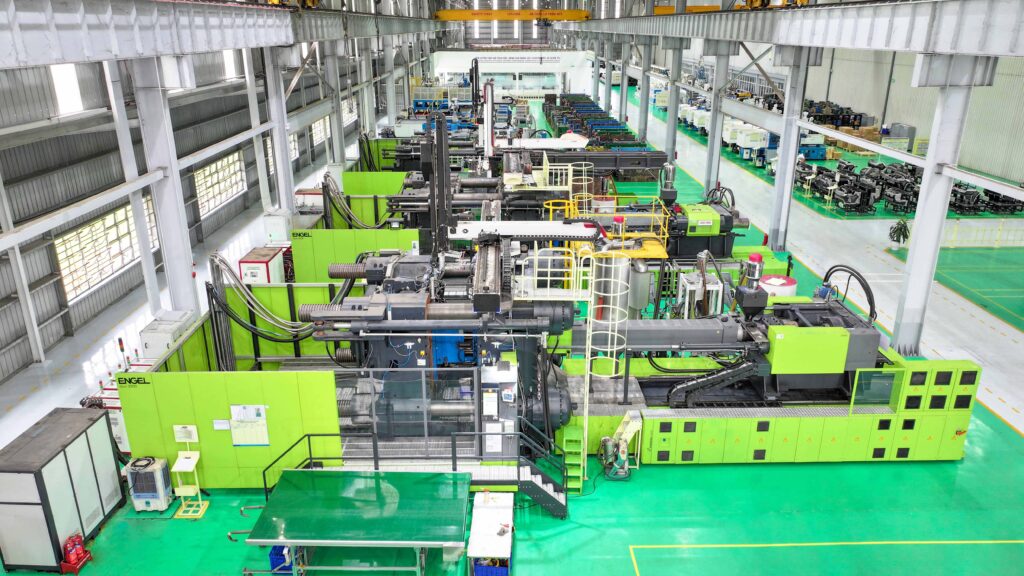
What Is an OEM Automotive Plastic Injection Mold?
An OEM automotive plastic injection mold is a high-precision metal tool used to manufacture plastic components for vehicles through the plastic injection molding process. Through precision-engineered molds, manufacturers mass-produce interior trim panels, dashboard elements, clips, connectors, air vents, and under-the-hood components. Key characteristics of OEM automotive injection molds include:
- Tight dimensional tolerances: Automotive molds must maintain high precision to ensure parts fit accurately.
- High durability for mass production: Typically made from hardened tool steels, these molds are designed to withstand repeated thermal cycles and high injection pressures while producing large production volumes.
- Compatibility with engineering plastics: Automotive molds are built to process materials such as polypropylene (PP), ABS, polycarbonate (PC), and nylon (PA), which offer heat resistance, impact strength, and long-term durability.
Automotive plastic injection molding operates through a highly controlled production cycle. Thermoplastic pellets are heated to a molten state and injected under high pressure into a precision-engineered mold cavity. They are then cooled and ejected as a solid part. The cycle repeats with high repeatability, enabling efficient mass production.
While the injection molding process remains largely consistent across automotive plastic components, mold configurations vary depending on part geometry, size, and production requirements.
These molds are manufactured using computer-aided design (CAD) systems and OEM vehicle data. Engineers run mold-flow simulations to predict the filling patterns, cooling efficiency, shrinkage, and potential defects.
Before the molds are used for large-scale production, they are validated through trial runs to check against surface finish, dimensions, material behavior, and fit with mating parts. This is where automotive quality standards such as IATF 16949:2016 come into focus.
Key Automotive Parts Produced Using OEM Injection Molds
When scaling vehicle production, you must ensure consistency across every unit. Inside the cabin, you’ll find automotive interior plastic parts such as:
- Dashboard panels and sub-panels
- Door trim panels
- Interior garnish and decorative trims
- Instrument panel plastic frames
These components must align perfectly and maintain finish quality over years of use. There is no room for warping, mismatch, or color inconsistency.
Outside the cabin, the requirements become tougher due to exposure to heat, debris, and UV rays. These are the exterior automotive plastic components in this category:
- Front and rear bumper covers
- Front grilles
- Side trims and exterior garnish parts
- Mirror housings
- Fender liners and wheel arch covers
The other automotive parts that rely on this manufacturing process are structural plastic components found under the hood. This type must withstand temperature swings and mechanical stress. They include:
- Engine covers
- Air intake manifolds
- Radiator end tanks
- Fan shrouds
- Battery trays
- Fluid reservoirs
Materials Used in OEM Automotive Plastic Injection Molding
As noted earlier, plastic injection molds are not made from plastic but from hardened metal. The choice of material directly affects cycle time, tool longevity, and dimensional stability. These aspects matter because production volumes are often high, making downtime quite expensive. The most common mold materials include P20 steel, H13 steel, S136 or 420 stainless steel, and aluminum.
Mold material selection depends on the production volume, processing conditions, and surface requirements of the part being manufactured. Hardened tool steels are often chosen for long production runs because they withstand heat and repeated cycles. In contrast, lighter materials are sometimes used for prototypes or shorter programs where faster machining and quicker turnaround are more valuable than long-term durability.
Here are the top engineering plastics that automotive manufacturers rely on:
- Polypropylene (PP / PP-Talc)
- ABS (Acrylonitrile Butadiene Styrene)
- Polyamide (PA6, PA66 / Nylon)
With automotive plastic injection molding, material selection and mold design are closely connected. Each plastic behaves differently during processing, so the mold must be engineered to match its flow, shrinkage, temperature demands, and wear characteristics. To better understand the production process, it’s important to examine the role these molds play throughout manufacturing.
Role of Plastic Injection Molds in Automotive Manufacturing
In OEM automotive programs, mold quality directly affects the surface finish and functional performance of plastic components used throughout the vehicle.
Core Functions
Plastic injection molds enable high-volume production of automotive components while maintaining consistent quality across every unit produced. They are engineered to hold tight tolerances over millions of molding cycles. This ensures a reliable fit during vehicle assembly. Mold design also supports complex part geometry and allows features such as ribs, clips, and mounting structures to be integrated directly into a single molded component. This is the backbone of modern automotive plastic parts manufacturing.
Supporting Lightweighting and Design Complexity
Lightweighting in automotive plastic components is achieved not only through material selection but also through advanced mold engineering. While some applications adopt thin-walled structures to reduce material consumption and overall weight, other components require greater wall thickness to meet structural strength requirements. Precision mold design enables manufacturers to optimize part geometry, balancing strength, durability, and material efficiency.
Vehicle plastic components produced using automotive injection molds contribute directly to higher performance and sustainability goals. Key benefits include:
- Improved fuel efficiency: Lightweight plastic parts reduce overall vehicle weight, lowering fuel consumption.
- Lower emissions: Reduced vehicle mass helps decrease CO₂ emissions over the vehicle’s lifecycle.
- Functional integration: Injection molds allow features such as ribbed stiffeners, snap-fit connections, and mounting points to be molded into a single component, replacing multiple smaller metal or plastic parts.
Impact on Quality & Performance
Plastic injection molds control surface finish and aesthetic consistency through the precision of the mold cavity and surface treatment. Mold design also influences structural integrity and part strength by ensuring balanced material flow and cooling during the molding process. In addition, properly engineered molds help maintain stability so components retain their shape and function throughout the vehicle’s lifetime.
Influence on Cost and Efficiency
Mold design influences cycle time, which determines how quickly plastic components can be produced in large volumes. Well-engineered automotive tooling also reduces downtime and supports automated production. This lowers the cost per part in high-volume manufacturing.
Alignment with Quality Systems
Plastic injection molds allow for consistent part production that meets dimensional approval standards required in OEM environments. Mold design and operation also support traceability and process control. This helps manufacturers maintain stable production and compliance with automotive quality systems
Enabling Electric & Smart Vehicle Innovation
As vehicles evolve, plastic injection molding now supports battery enclosures, lightweight structural parts, sensor housings, cable management systems, and advanced interior designs. Through precise mold engineering, manufacturers can produce these complex components with the accuracy and consistency required for modern vehicle systems.
Because molds shape so much of automotive production, selecting the right manufacturing partner becomes a strategic decision. OEM programs require proven engineering depth, production scale, and disciplined process control. This is where the capabilities of a specialized mold manufacturing factory become crucial.
THACO INDUSTRIES – A Trusted Partner for OEM Automotive Plastic Injection Mold Solutions
THACO INDUSTRIES operates as a large-scale integrated manufacturing complex supporting OEM and Tier-1 automotive production programs. The company operates an integrated industrial campus 320 hectares with 20+ manufacturing plants. This structure enables a coordinated production ecosystem that links engineering, tooling development, and component manufacturing.
Within this integrated manufacturing ecosystem, the Molding Company focuses on the design and manufacturing of plastic injection molds for automotive applications. The company has invested in modern production lines featuring equipment imported from Germany, Japan, and South Korea, meeting an annual capacity of 1,000 mold sets and 3,000 tons of precision mechanical components.
A key pillar of this capability is the company’s 30,000 m² R&D center, equipped with advanced technologies for product design, simulation, testing, and prototyping. The center also supports customized product development based on specific customer requirements. And engineering teams leverage modern CAD/CAM systems, mold-flow simulation software, and validation laboratories to ensure product quality before mass production begins.
Quality compliance at THACO INDUSTRIES is also aligned with international expectations:
- IATF 16949:2016 for automotive quality management
- ISO 9001:2015 for quality systems
- ISO 14001:2015 for environmental management
- ASTM Standards – Material and testing specifications
- ISO 3834 – Quality requirements for welding
THACO INDUSTRIES manufactures and supplies a wide range of high-quality molds and tooling solutions, including:
- Plastic injection molds for bumpers, luggage trims, front grilles, and wheel covers
- Stamping dies for seat frames, sunroof frames, exhaust hangers, and reinforcement components
- Extrusion and blow molds for trims, spoilers, piping, and shaped profiles
- Precision tooling for broader industrial applications
Beyond automotive manufacturing, THACO INDUSTRIES also supports mold production for multiple sectors including industrial equipment, agriculture, and consumer products. The company continues to expand its mold supply to domestic OEMs and international markets such as Australia, the United States, Malaysia, Canada, and Denmark.
Moving forward, THACO INDUSTRIES continues to strengthen its capabilities as a reliable OEM and Tier-1 manufacturing partner for automotive customers. By strengthening its capabilities in precision tooling and large-scale manufacturing, the company aims to support the evolving needs of the automotive industry while building long-term partnerships with customers worldwide.
THACO INDUSTRIES is a manufacturing corporation specializing in automotive parts manufacture for global markets. Its product portfolio covers auto body parts, automotive interior and exterior parts (radiator and condenser assembly, and integrated systems for automotive wiring harness, and more). All production activities are carried out according to international standards, including IATF 16949, ISO 14001, 45001 and ISO 9001 certifications, ensuring stable quality and consistency. With strong in-house capabilities in R&D and manufacturing, THACO INDUSTRIES operates as a reliable automotive original equipment manufacturer (OEM) and ODM partner, delivering scalable solutions that fully comply with international technical standards.
For further discussion on OEM automotive tooling or manufacturing requirements, partners can connect directly with THACO INDUSTRIES’ team at partsales@thaco.com.vn or via (+84) 389 067 557 (Ms. Linh) to explore tailored solutions for your next project.


