
Automotive Components
Automotive Plastic Parts Manufacturer for OEM and Tier-1 Suppliers
Plastic components are built into almost every vehicle today, serving both visual and functional purposes across interior and exterior applications. Behind those parts is a manufacturing process that needs to balance quality, consistency, and production efficiency. For OEMs and Tier-1 suppliers, choosing an automotive plastic parts manufacturer means choosing a partner that can meet specifications while keeping supply dependable over the life of a program.
What “OEM and Tier-1 Suppliers” Mean
In the automotive industry, OEMs (Original Equipment Manufacturers) are companies responsible for designing and producing vehicles, including passenger cars, trucks, and buses. These manufacturers operate vehicle assembly plants where thousands of components are integrated into the final product. Plastic components produced by automotive plastic parts manufacturers are shipped directly to vehicle assembly plants, where they are installed during stages such as body assembly and interior installation. Because these production lines operate continuously, OEMs expect suppliers to:
- Maintain stable long-term production
- Support high-volume manufacturing programs
- Follow a strict zero-defect mindset to prevent disruptions on the assembly line
Tier-1 suppliers, on the other hand, operate one level upstream in the automotive supply chain. These companies produce complete systems or modules for OEMs, including seating systems, door modules, front-end modules, and other integrated interior/exterior components. Plastic parts manufacturers often support Tier-1 suppliers by:
- Supplying molded components that are integrated into these modules
- Assisting with tooling and production support. This helps Tier-1 suppliers to maintain consistent part quality and production efficiency
Given the strict performance and reliability expectations placed on OEMs and Tier-1 suppliers, component production must meet the same standards. This responsibility typically falls to automotive plastic parts manufacturers.
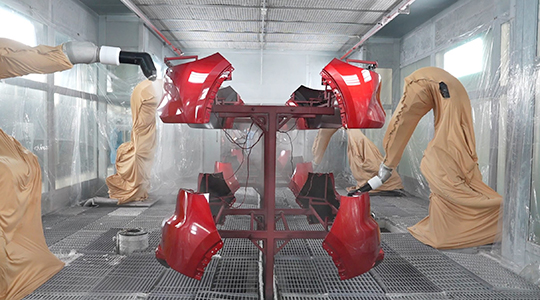
Inside THACO INDUSTRIES Plastic Components Company
What Does an Automotive Plastic Parts Manufacturer Do?
An automotive plastic parts manufacturer focuses on turning component designs into high-volume molded parts that can be integrated into vehicle assemblies. This work enables seamless integration into OEM production programs and Tier 1 module systems.
Relationship Between Plastic Parts Manufacturers & OEMs
In automotive plastics manufacturing, plastic components are supplied directly to OEM vehicle assembly plants. These parts are integrated into the vehicle during multiple stages of production, including:
- Body assembly
- Interior assembly
- Final vehicle assembly
Manufacturers must align production schedules and quality requirements with OEM programs to ensure components arrive ready for installation without interrupting assembly line operations.
Relationship Between Plastic Parts Manufacturers & Tier-1 Suppliers
Plastic parts manufacturers also support Tier-1 suppliers that deliver complete vehicle modules to OEMs. In this relationship, manufacturers supply automotive plastic components produced through injection molding for integration into larger interior or exterior systems. Beyond component production, they may also support tooling and production continuity by:
- Manufacturing or maintaining injection molds
- Producing high-precision plastic parts for module integration
- Maintaining a consistent supply to support uninterrupted module assembly
In addition to injection molding, manufacturers may also utilize extrusion and blow molding processes to expand their production capabilities and support a wider range of automotive components. For OEMs and Tier-1 suppliers, this broader manufacturing capability improves sourcing flexibility, supports localization, and helps maintain production continuity.
To support these supply relationships and the strict production expectations of OEMs and Tier-1 suppliers, plastic parts manufacturers must perform several defined technical and operational responsibilities. These responsibilities guide component production, mold management, and controlled production processes.
Core Responsibilities of Plastic Parts Manufacturers
Modern vehicles need high-precision plastic components that support safety and performance. Plastic parts manufacturers, therefore, play a crucial role in component manufacturing, mold support, and process control.
Plastic Component Manufacturing
Plastic component manufacturing is the primary activity of automotive plastics production. Manufacturers use processes such as injection molding, extrusion, and blow molding to produce parts that meet the design, material, and performance requirements defined by vehicle programs.
In addition, manufacturers produce automotive plastic components and assemblies that support vehicle production and final assembly. This ensures compliance with applicable technical specifications and quality standards required by OEM and Tier-1 supply chains.
Tooling & Mold Supporting
Some automotive plastic parts manufacturers may provide mold supporting services, including the design, production, or maintenance of injection molds used for automotive parts production. These molds must be durable enough to support long production lifecycles and capable of sustaining high-volume output without dimensional variation.
Manufacturers also optimize mold performance to improve cycle time and maintain quality stability. Proper mold maintenance and parameter control help ensure parts remain consistent across long production runs.
Production Process Control
Maintaining consistent quality in plastic manufacturing depends heavily on stable production conditions. In high-volume production environments, manufacturers monitor processing parameters and conduct in-process inspections to ensure that injection-molded automotive parts meet the required specifications before they reach downstream assembly lines. This is done by:
- Maintaining stable molding parameters
- Monitoring quality during production
- Preventing defects before parts reach OEM or Tier-1 lines
Beyond process control, material choice is another key factor that determines whether manufacturers can consistently meet industry requirements.
Materials Used in Automotive Plastic Parts
Automotive plastic components are typically produced from a limited number of polymers selected for their strength, weight efficiency, and molding performance. Materials such as polypropylene, polyurethane, and ABS are widely used across vehicle interiors, exterior panels, and functional components because they can meet both manufacturing and durability requirements in automotive applications.
Polypropylene (PP):
- Usage share: Approximately 37%
- Properties: Lightweight, good chemical resistance, strong fatigue resistance, and cost efficiency
- Common applications: Interior trim panels, battery cases, bumpers, and under-the-hood components
Polyurethane (PU/PUR):
- Share: Around 15% usage
- Properties: Flexible structure, excellent cushioning performance, strong durability, and vibration absorption
- Common applications: Seat foam, interior padding, insulation components, and energy-absorbing structures
Acrylonitrile Butadiene Styrene (ABS):
- Share: Approximately 7% usage
- Properties: High impact resistance, improved dimensional stability, better stability, good surface finish, and ease of molding
- Common applications: Dashboard components, interior trim parts, and electronic housings
Material selection alone does not determine whether a plastic component will perform reliably in automotive applications. Manufacturers must also ensure these plastics perform reliably in demanding automotive environments. So, how do manufacturers ensure these materials perform consistently and safely in automotive applications? It comes down to quality control and standards.
What Quality Standards Are Important to Automotive Plastics Manufacturing?
Automotive plastics manufacturing operates under strict quality requirements because plastic components must meet safety and performance expectations throughout a vehicle’s lifecycle. For this reason, manufacturers follow internationally recognized standards that govern quality management, production processes, and environmental compliance. The standards outlined below represent some of the most important frameworks used across the automotive industry. These certifications and assessments form the foundation for maintaining consistent product quality and meeting OEM and Tier-1 supplier requirements.
Global Quality Management Systems (QMS)
Quality management systems provide the structure that manufacturers use to control processes, documentation, and continuous improvement across their operations. Two widely recognized certifications guide automotive manufacturing environments:
- IATF 16949:2016: The global quality management standard specifically developed for the automotive industry. It focuses on defect prevention, process control, and continuous improvement across the supply chain.
- ISO 9001:2015: A broader international quality management standard that establishes systematic procedures for quality assurance, documentation, and operational consistency.
“Special Process” Assessments (Molding Specific)
Plastic injection molding is considered a specialized process because certain quality issues, such as internal stress, incomplete filling, or weak knit lines, cannot always be detected solely by visual inspection. As a result, manufacturers rely on process assessments that evaluate how molding operations are controlled.
- AIAG CQI-23 (Molding System Assessment): Evaluates molding process capability, equipment condition, and parameter control.
- VDA 6.3 (Process Audit): A structured audit used to assess manufacturing processes and ensure production stability across the supply chain.
Environmental & Chemical Safety
The standards below govern environmental responsibility and chemical safety regulations in plastics manufacturing.
- Decree 08/2022/ND-CP (EPR): As of 2025, the Extended Producer Responsibility (EPR) regulations require manufacturers to recycle a defined portion of plastic products or contribute to the Vietnam Environmental Protection Fund.
- RoHS Compliance: Restricts the use of hazardous substances in materials used for electronic components, including plastic housings and vehicle connectors.
Ultimately, OEMs and Tier-1 suppliers look for manufacturing partners that support high-volume production programs while integrating smoothly into global automotive supply chains.
Partner with THACO INDUSTRIES: End-to-End Automotive Manufacturing Solutions
THACO INDUSTRIES is an OEM/ODM manufacturing service provider within the Chu Lai Industrial Complex (in Da Nang city), where multiple production facilities are connected through a vertically integrated industrial system. This setup enables component fabrication, engineering support, and large-scale manufacturing within a single integrated ecosystem.
The corporation manufactures a wide range of automotive and motorbike plastic components, including bumpers, side trims, mudguards, and luggage compartments. Products are developed according to OEM specifications and supported by a production system that combines plastic injection molding, extrusion, blow molding, and automated color-painting robots. With these technologies, THACO INDUSTRIES can handle diverse product requirements while maintaining a production capacity of up to 12 million plastic components per year.
THACO INDUSTRIES delivers end-to-end solutions for OEMs and Tier-1 suppliers. Manufacturing operations follow internationally recognized quality standards, including IATF 16949:2016, ISO 9001:2015, and ISO 14001:2015 for environmental management. Through this production network, THACO INDUSTRIES supplies automotive plastic components to several international markets, including Australia, the United States, Malaysia, and Canada.
THACO INDUSTRIES is a manufacturing corporation specializing in automotive parts manufacture for global markets. Its product portfolio covers auto body parts, automotive interior and exterior parts (radiator and condenser assembly, and integrated systems for automotive wiring harness, and more). All production activities are carried out according to international standards, including IATF 16949, ISO 14001, 45001 and ISO 9001 certifications, ensuring stable quality and consistency. With strong in-house capabilities in R&D and manufacturing, THACO INDUSTRIES operates as a reliable automotive original equipment manufacturer (OEM) and ODM partner, delivering scalable solutions that fully comply with international technical standards.
You can learn more about these capabilities at THACO INDUSTRIES’ Plastic Components Company, which is a dedicated facility for automotive plastic manufacturing.
For OEMs and Tier-1 suppliers seeking a reliable manufacturing partner, THACO INDUSTRIES offers the technical capability, production scale, and quality systems required for long-term programs. Contact THACO INDUSTRIES to discuss your next manufacturing or OEM project via partsales@thaco.com.vn or (+84) 389 067 557 (Ms. Linh).


