
Automotive Components
Custom Steel Wheel Solutions Built for Automotive OEM Requirements
As vehicle manufacturers continue to optimize vehicle platforms for durability and operational reliability, demand has grown for custom steel wheel solutions engineered to meet specific structural and performance requirements. OEMs increasingly require wheels tailored to the load conditions, fitment parameters, and service environments of each vehicle platform. This guide outlines how custom steel wheels are engineered and validated to meet OEM requirements for safety, durability, and structural reliability.
What Are Custom Steel Wheels?
Custom steel wheels are built to meet a specific vehicle requirement rather than being pulled from a standard catalog. Instead of adjusting the vehicle to fit the wheel, the wheel is built around the vehicle, from the load profile, axle configuration, and brake system to the operating environment. This is how bespoke steel wheels differ from off-the-shelf options.
Structurally, a steel wheel consists of two primary components: the rim, which supports the tire bead, and the disc center, which connects the wheel to the hub. In heavy-duty applications, these components function as part of load-bearing wheel systems designed to withstand static loads, dynamic forces, and impact loads throughout long service life. The following design parameters are engineered to meet the vehicle’s mechanical load requirements:
- Thickness of the steel
- The contour of the rim
- The weld integrity
- The bolt pattern
In commercial transport and industrial applications, heavy-duty steel rims are widely used for their ability to withstand high loads and harsh operating conditions. Typical applications include trucks, buses, trailers, agricultural machinery, and construction equipment.
Differences Between Custom and Standard Steel Wheels
A standard steel wheel is designed based on common vehicle specifications. It often fits a wide range of models and works well in predictable conditions. This makes them a practical and cost-efficient option for general use.
In contrast, custom steel wheels are engineered to meet specific technical requirements such as:
- Design parameters: Standard wheels follow fixed dimensions, while custom wheels adjust offset, disc thickness, bolt pattern, load rating, and rim contour based on the application.
- Intended environment: Agricultural equipment operating on wet soil and uneven terrain requires different reinforcement than a highway truck. Similarly, construction fleets hauling aggregates place greater stress on the wheel disc than municipal buses.
- Certification and compliance: Industrial wheels may require strict load validation or specs depending on the sector and region. On the other hand, commercial-use wheels often follow broader transport standards.
While standard steel wheels offer convenience and lower upfront cost, custom steel wheels provide greater design flexibility and performance alignment with the vehicle’s intended use.
Core Capabilities That Define a Custom Steel Wheel Manufacturer
A custom wheel rims manufacturer handling OEM programs must invest heavily in engineering control and production depth. Custom wheels are structural components that rely on proper design and process discipline.
Advanced Engineering & Custom Design Capability
Steel wheels are typically produced through stamping and roll forming and welding processes, rather than casting. The disc geometry, rim profile, and mounting surface must align with load capacity and fatigue performance.
With modern CNC machining technology, wheel hub interfaces, bolt patterns, and mounting faces can be manufactured to exact tolerances. That allows OEMs to request thickness adjustments or reinforcement designs without affecting fit.
High-Precision Manufacturing Technology
Consistency comes from controlled production processes. These include:
- Precision stamping and roll forming operations
- Automated welding for welded steel rims
- Machining processes to maintain concentricity
Surface treatment is also critical for long-term durability. Two common protection coating layers include:
- ED coating: Provides a corrosion-resistant base layer
- Powder coating: Ensures uniform coverage and mechanical durability
Protection is validated through salt-spray testing, adhesion checks, and accelerated weathering tests.
Material Selection and Steel Grades
Many commercial steel wheels are produced using carbon steels such as SAE 1010, 1020, or similar grades. These offer good formability, which is important during steel wheel forming, especially for rim rolling and disc stamping. They are suitable for medium-duty trucks and trailers with predictable load demands.
In heavier-duty applications, manufacturers may adopt high-strength low-alloy (HSLA) steels. Compared with standard carbon steels, HSLA grades provide higher yield strength and improved fatigue resistance, allowing wheels to withstand higher loads or repeated stress cycles without increasing material thickness. In construction vehicles or equipment carrying concentrated loads, HSLA steels provide higher structural strength and load-bearing capability. However, HSLA materials require stricter process control during forming and welding operations.
Quality Management & OEM Compliance
Before custom wheels are approved for shipment, they must meet dimensional tolerance, load standards, and interchangeability requirements. Certifications such as ISO 9001:2015, ISO 14001:2015, or CE marking demonstrate regulatory compliance and facilitate market access.
To meet regulatory requirements and global market standards, production programs apply structured quality planning tools such as PPAP documentation, control plans, and statistical process control. These systems support efficient root-cause analysis and ensure audit readiness for global OEM programs.
Reliable Delivery Production
OEM programs run on fixed production timelines. A manufacturer with scalable capacity can adjust output volumes while maintaining consistent specifications across batches. Structured planning and clear coordination between engineering and production teams reduce the risk of delay when design updates or quantity changes occur.
Quality Standards and Certifications for Custom Steel Wheels
Custom production only makes sense if the finished wheel meets strict market standards as well as specifications from buyers. Buyers are not paying for flexibility alone; instead, they expect documented performance and traceable compliance.
Dimensional Accuracy Checks
Every wheel must match approved drawings. That means verifying bolt circle diameter, offset, center bore, rim width, and runout tolerance. In most programs, quality control steel wheel procedures include measuring concentricity and inspecting welds before surface treatment begins.
Load and Fatigue Testing
Radial load testing confirms the wheel can carry its rated capacity without any defects. Depending on the application, impact resistance may also be assessed. All these procedures ensure proper durability testing and help prevent premature cracking or deformation in service.
Compliance with International Standards
Working with an ISO-certified wheel manufacturer provides documented process control. Certifications such as ISO 9001:2015 demonstrate alignment with international requirements. Incoming steel materials undergo chemical composition and mechanical property inspection before entering forming operations such as stamping, rolling, and precision machining. These standards ensure that customized steel wheels meet global OEM performance and reliability requirements.
Common Customization Options for Custom Steel Wheels
Custom steel wheels are often part of OEM programs that define specifications based on vehicle architecture and market positioning. Due to a large margin of money pouring into annual maintenance, the OEM segment saw an increase of 13% Year-on-year, since OEM manufacturing can now offer different aftermarket customized options, like corrosion-resistant coating, or appealing steel wheels that are captivating.
Therefore, these adjustments affect performance and compatibility in the following ways, positioning OEM Steel Wheel as a new alternative for long-term usage:
Diameter, Width, and Offset Customization
Diameter and rim width must align with tire selection and brake system clearance. Offset influences how the wheel sits relative to the hub and suspension components. Even minor changes can alter load distribution and steering geometry, which is why custom rim sizes are determined from technical drawings and validation data.
Load Capacity and Application Tuning
Wheel load ratings are calculated according to axle load and duty cycle. A refuse truck and a construction vehicle, for example, will not share the same reinforcement strategy: the refuse truck’s wheels need to withstand deterioration from frequent stop-start cycles, while engineers have to pay more attention to tackle extreme stress, and harsh, uneven terrain when operating construction vehicles. As a result, disc thickness and forming profile must be adjusted to meet the required safety margin.
Branding and Private-Label Manufacturing
Many OEM steel wheel programs include stamped logos and specific coating finishes. Here, the wheel meets technical standards and supports the customer’s brand identity in the market.
Four Reasons Why THACO INDUSTRIES is Your Ideal Custom Steel Wheels Manufacturer
Choosing the right steel wheel manufacturer is a strategic decision, which could affect quality and long-term program stability. Established itself as a leading custom steel wheel manufacturer in Vietnam, THACO INDUSTRIES has combined integrated production, advanced engineering, and global supply capability. These are key reasons why THACO INDUSTRIES is an ideal custom steel wheel partner.
Rigorous Procedure With OEM Production Capacity
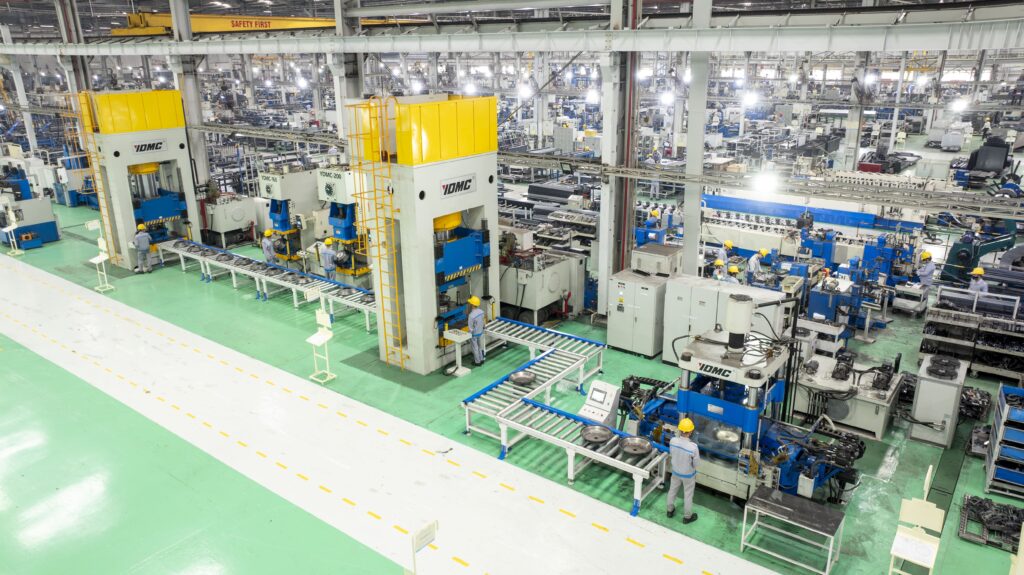
THACO INDUSTRIES runs an integrated All-In-One value chain in which Business, R&D, Manufacturing, Installation, Warranty & Repair are operated within a single coordinated system. Each stage connects to the next, which helps maintain uniform quality across components and production batches.
Technology is used throughout the line, from controlled forming, precision machining to welding systems. Besides, hardness-testing machines, ultrasonic inspection equipment, and universal mechanical material-testing machines also contribute to quality management.
As a strategic large-scale automotive components & parts manufacturing partner to Kia, Mazda, BMW, Peugeot, Toyota, and Hyundai, THACO INDUSTRIES demonstrates the process discipline and production standards required by global automotive OEMs.
Professional Engineers With Expertise
With experienced engineering teams and specialists working within a modern research environment that includes design centers, materials testing laboratories, and prototype workshops, THACO INDUSTRIES ensures that every product concept can be translated into reliable, large-scale production while maintaining strict quality control.
This engineering expertise enables THACO INDUSTRIES to operate as a trusted truck wheel rims manufacturer for global OEM and aftermarket customers. THACO INDUSTRIES operates in an ISO 17025:2017-compliant laboratory environment. Engineers follow an eight-step development process covering:
- Order acceptance
- Order evaluation and survey
- Solution research
- Solution design
- Solution approval
- 3D design, durability testing, 2D Design, BOM preparation
- Handover
Global Export and Logistics Support
THACO INDUSTRIES supplies export-ready steel wheels through flexible multimodal transport solutions, utilizing an integrated logistics network that combines road, sea, and port transportation. This logistics model enables streamlined supply chain operations, improved shipment visibility, and reduced overall logistics costs for international partners. It ensures reliable delivery schedules, efficient customs processing under international trade terms, and scalable logistics solutions that support long-term OEM supply chain stability.
Proven International Qualification
Operations at THACO INDUSTRIES comply with IATF 16949:2016, ISO 9001:2015, ISO 14001:2015, ISO 45001:2018, EN 1090, and ISO 3834.
That means every component meets strict international manufacturing and export standards. Choose THACO INDUSTRIES as your custom steel wheel manufacturing partner and move forward with confidence in quality, compliance, and delivery.
THACO INDUSTRIES is a manufacturing corporation specializing in automotive parts manufacture for global markets. Its product portfolio covers auto body parts, automotive interior and exterior parts (radiator and condenser assembly, and integrated systems for automotive wiring harness, and more). All production activities are carried out according to international standards, including IATF 16949, ISO 14001, 45001 and ISO 9001 certifications, ensuring stable quality and consistency. With strong in-house capabilities in R&D and manufacturing, THACO INDUSTRIES operates as a reliable automotive original equipment manufacturer (OEM) and ODM partner, delivering scalable solutions that fully comply with international technical standards.
From concept to delivery, THACO INDUSTRIES supports OEM partners with structured processes and advanced manufacturing capabilities. For detailed discussions on your next custom steel wheel project, please contact partsales@thaco.com.vn or (+84) 389 067 557 (Ms. Linh)


