
Automotive Components
OEM Precision Machined Components: Understanding the Fundamental Qualification in Manufacturing
Precision-machined components (PMCs) are crucial to modern manufacturing, especially in OEM(Original Equipment Manufacturer) precision machining, where dimensional accuracy directly affects product performance. In OEM production, these components are used to meet strict design specifications without adjustment.
In this article, THACO INDUSTRIES explains the concept of precision-machined components and their role in manufacturing before highlighting their applications in aerospace, automotive, and electronics.
What are Precision-Machined Components?
Precision-machined components (PMCs) are highly accurate parts produced through CNC precision machining. These tight-tolerance components are strictly required in critical applications such as medical instruments, aerospace, and electronics, where even a 0.001mm deviation can result in system failure or limited performance.
Beyond accuracy, PMCs are defined by repeatability, which means thousands of parts can be produced with the same dimensions and surface finishes.
Custom-machined parts are often required in OEM projects to meet specific design tolerances. This ensures uniformity across complex system assemblies such as engines and electronic machines.
Benefits of Precision-Machined Components in the OEM Industry
In production environments that rely on exact specifications, precision-machined components determine how well parts fit, how smoothly assemblies run, and how stable output remains over time. Below are the advantages of using precision-machined components in the OEM industry.
Dimensional Accuracy and Repeatability
OEM precision-machined components are produced to tight tolerances, so they match complex design requirements without deviation. This level of control supports intricate geometries, such as medical implants and turbine components, where fit and positioning must follow the original design.
These components are used in multiple industrial equipment: robotics, consumer electronics, and satellite systems are all structured by these small components. In these applications, even a small variation can affect assembly or disrupt operation, causing resource waste. Repeatability across batches keeps every unit within the same specification, rather than treating accuracy as a one-off outcome.
Cost-Effectiveness for Mass Production
CNC precision machining supports scalability in high-volume OEM production by maintaining a stable and controlled process. When the production chain is consistent, material waste and rejected parts remain low, which lowers total manufacturing cost per unit over large production runs.
OEM precision-machined components also support interchangeability, which means defective parts can be replaced instantly without recalibration which reduces downtime in production lines.
Long-Lasting Quality
Precision manufacturing improves component performance by reducing wear and alignment issues during operation. With OEM Precision Components, OEMs can enhance surface quality and functional performance with additional technological advancements. This is crucial in industries where downtime or failure carries a high cost.
Modern machining technology also allows components to be produced at smaller scales while meeting the required specifications. It’s not about one part being produced immaculately, but a combination of hundreds of accurate parts across all products.
Stronger Quality Control
Quality control in OEM precision-machined components is another advantage, where inspections at multiple stages of production are conducted thoroughly to confirm tolerance compliance. Measurements are verified during machining and after completion, so any deviation identified early can be eliminated on time before passing down the line.
For this level of control, OEMs rely on in-house production and inspection capabilities. Each batch is handled under the same conditions, with the same standards applied from start to finish. This approach prioritizes long-term durability and compliance with exact specifications rather than short-term cost savings.
What OEM Industries Rely on Precision-Machined Components
Precision-machined components appear wherever performance depends on exact specifications and stable operation. As manufacturing systems become more complex, OEM industries rely on these components to produce parts that fit correctly and maintain material durability over time. This reliance becomes more apparent in sectors that operate under demanding conditions and where systems require consistent performance across every component.
Automotive Industries
Precision machining in automotive manufacturing is used to produce engine components such as pistons, camshafts, cylinders, valves, and engine housings. These parts operate under heat, pressure, and continuous motion, so even minor variations can affect performance tremendously.
OEMs also manufacture body components for passenger cars, trucks, and buses, along with chassis components and structural frames. These backbone components form the mechanical structure of the vehicle and must align with the provided specifications during assembly.
Spare Parts
Mechanically machined spare parts are used in many industries such as automobile manufacturing, shipbuilding, industrial machinery, aircraft, and household equipment. Their value comes from material durability and consistent machining accuracy, which allows them to perform reliably under repeated mechanical stress. If there is any deviation from existing components, buyers can easily replace them with other parts from the same batch to utilize costs.
These components not only support localization in domestic vehicle production, but also adhere with export requirements in demanded markets such as the US, Canada, Mexico, and the EU.
Material Handling Equipment
Precision-machined components are also widely applied in material handling equipment, such as carton sealing machines and conveyors, where optimum operation can accelerate the production chain immensely. These systems depend on accurately machined parts to maintain steady operation.
This capability is supported by manufacturers with expertise in structural and mechanical component production, such as the Specialized Equipment Company under THACO INDUSTRIES. These machines form part of functional complex systems, where each component contributes to continuous movement.
Electrical Civil Components
In mechanical construction and MEP (Mechanical, Electrical & Plumbing) systems, precision components are applied across R&D, processing, installation, and maintenance. This scope of work is reflected in specialized units such as the Mechanical and Electrical Refrigeration Company under THACO INDUSTRIES.
These systems follow strict standards such as TCVN 10307:2014 and TCXDVN 170:2007, which ensure verified quality control during construction and compliance with required safety and technical specifications, including the use of corrosion-resistant components for long-term operation.
Agriculture
Agricultural equipment relies on precision-machined engine parts, transmission gears, and hydraulic components to maintain stable operation under heavy loads and varying field conditions. Tractors and tillage machines operate in abrasive soil environments, where components must retain their shape and fit despite continuous use.
Precision-machined components address this by maintaining exact specifications across moving parts, which supports smooth power transmission and reduces premature wear during operation.
High-strength brackets and cutting blades are designed to withstand abrasive soil conditions and sustained mechanical loads, supported by R&D-driven machining processes. This is often applied in agricultural equipment manufacturing, where component durability depends on how well design and machining are aligned with real operating conditions.
At THACO INDUSTRIES, precision-machined components are developed with support from an in-house R&D center, where engineering and machining teams work together to optimize designs based on operating conditions and specific equipment requirements. This setup enables continuous adjustment of component structure and material use to match field performance demands.
Electronics
In semiconductors and connector systems, microscopic tolerances are required to ensure electrical conductivity and system reliability, often defined by material-specific tolerances. Precision-machined components find their applications in these critical systems because they maintain exact geometries and surface integrity needed for stable signal transmission and consistent contact performance.
Medical
Medical devices is another sector that depends on components produced to exact specifications, especially for surgical and diagnostic equipment. Tolerances are extremely tight, and minor deviations can affect performance in clinical use, leading to unprecedented accidents while operating.
Aerospace
Aerospace components are built with a focus on strength-to-weight optimization and precise performance. Parts such as turbine blades and structural elements must function under high stress and varying temperatures. Precision machining is used to produce aerospace components such as turbine blades, which play a key role in thrust generation and contribute to overall engine efficiency.
Key Factors When Choosing a Precision Machining Partner
Choosing the right OEM precision machining partner directly affects product quality and long-term supply reliability. The decision goes beyond cost, as it directly affects how parts are produced, inspected, and delivered over time. These are the key aspects to watch:
- Manufacturing expertise and capacity: OEMs aiming for flexible production require partners with engineering expertise and advanced CNC precision machining capabilities. This sometimes requires modern computer software for specific adjustment, meeting specifications from customers.
- Quality assurance systems: Standard certifications form the baseline, but some projects may require additional approvals tied to specific international markets.
- Long-term supply reliability: One supply chain failure can cause costly delays, missed deadlines, or even safety risks. That’s why supplier reliability is essential for compliance and growth. In the event of a component failure, being able to trace its source and quickly replace it also helps increase the reliability of the manufacturing plant.
- Ethical compliance: This supports stable workforce conditions, as production consistency must go hand in hand with labor protection, safe working environments, and fair practices that enable workers to maintain focus and meet manufacturing requirements without compromising working conditions.
THACO INDUSTRIES – An Ideal Partner Tailored to Your Needs
THACO INDUSTRIES operates as a pioneer in OEM precision machining manufacturing in Vietnam, offering integrated solutions across multiple sectors. With a USD 240-million investment in Mechanical Complex Center, covering an area of 200,000 m², THACO INDUSTRIES is equipped with advanced technology lines imported from Germany, Switzerland, Japan, and South Korea, meeting an annual capacity of 250,000 tons of steel and 300,000 mechanical products.
Highlighted niche from THACO INDUSTRIES’s mechanical complex center concentrates on OEM precision machining, with processes such as turning, milling, cold working, mechanical processing, and aluminum casting for vehicle bodies, automotive mechanical components, agricultural and industrial equipment, construction machinery, and other mechanical components.
THACO INDUSTRIES also produces precision-machined components that meet OEM production standards. Its all-in-one manufacturing value chain combines design, machining, and assembly within one production chain, adhering to ethical practices under ISO 45001:2018. This commitment supports a safer, well-regulated working environment, which directly manages to operate stable production and consistent output.
The company applies advanced technologies across its precision machining operations, including:
- Fiber-laser cutting machines
- 5-axis CNC milling machines
- CNC gun drilling machines
- 2-head EDM machines
- Wire-cutting machines
- Hydraulic die-spotting press machines
- PX Salvagnini automatic bending machine
- Servo CNC Amanda stamping machine
- 500-ton hydraulic press machine
- SB-52-10A-2S-V-U tube bender
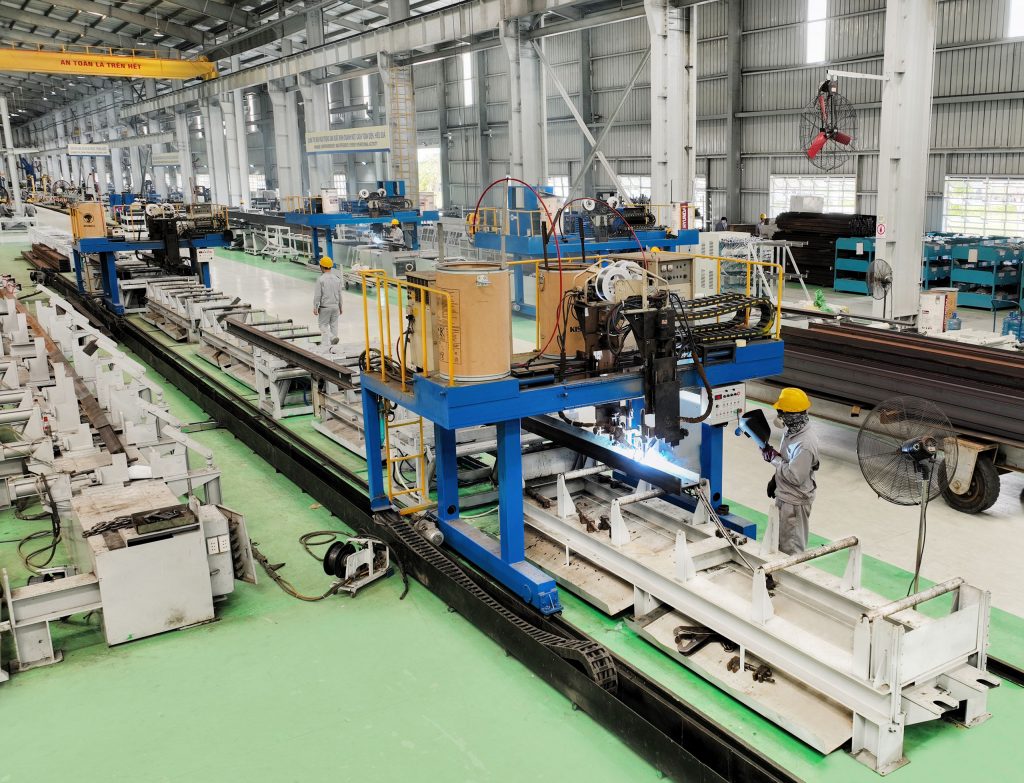
- Automated welding robots
For OEM precision machining in Vietnam, THACO INDUSTRIES supports high-demand industries with scalable output, tight tolerance components, and a supply chain built to keep production on track, bringing satisfaction to customers from the all-in-one value chain.
Contact THACO INDUSTRIES, one of the trusted Precision Machined Components manufacturers Vietnam, to explore customized component manufacturing solutions that enhance efficiency and support long-term operational success across diverse industrial applications.
To explore tailored precision-machined component solutions for your next OEM or manufacturing project, contact THACO INDUSTRIES via partsales@thaco.com.vn or (+84) 389 067 557 (Ms. Linh) for direct consultation and technical support.


