
Automotive Components
Key Factors That Define a Reliable Industrial Rims Manufacturer
A reliable partner is defined by more than product range: proven quality control, certified materials, modern manufacturing capability, and the ability to meet tight tolerances at scale all determine whether rims perform under real-world loads and harsh operating conditions.
When these factors are in place, customers gain fewer failures, smoother operations, and confidence that every delivery meets the same standard across the production chain. This guide navigates what are the reliable key factors that separate a truly reliable industrial rim manufacturer from the rest.
What is an Industrial Rim? Some Significant Advantages of Industrial Rims
Industrial rims are heavy-duty wheel rim assemblies used on industrial and heavy-duty machines like forklifts, mining/haul trucks, tractors, loaders, and other earthmoving equipment. Their core job is to seat and support the tire and transfer extreme loads and impacts from the tire into the axle structure.
Depending on the application, an industrial rim may be single-piece or multi-piece: regulators and safety references define a multi-piece wheel as one made of “two or more parts,” including a side ring that holds the tire on the wheel when inflated, and government guidance commonly describes wheel/rim assemblies as including parts such as a rim base, flanges, bead seat band, lock rings, and O-ring.
The biggest advantages of industrial rims come from strength, durability, and safety-concentrated design. Many heavy equipment rim systems use high-strength steels (e.g., HSLA-grade steel for critical components) and sturdy geometries to resist deformation, fatigue, and impact damage in harsh environments helping protect tires, maintain stability, and extend service life.
Types of Industrial Rims Manufactured
Different applications require specific rim configurations. Below are the most commonly used rim types and their typical functions.
Multipiece Wheels
These wheels are built for heavy-duty applications. Their segmented construction allows them to support pneumatic and solid tires used in high-load environments that require impact resistance and long-term structural durability. These wheels are widely applied in port container handlers, warehouse reach stackers, and large agricultural tractors.
Several industries require multipiece wheels for proper function. For instance, in farming applications, these configurations are widely used as agricultural machinery rims to support low-pressure tires that reduce soil compaction. In construction and mining environments, reinforced variants serve as construction equipment rims and heavy-duty off-road vehicle rims, engineered to endure abrasive conditions, shock loads, and extreme operating stress. Thick-gauge steel sections combined with high-strength welding ensure exceptional impact resistance, fatigue durability, and long-term structural integrity under continuous high-load operations.
Split Wheels
Split wheels are commonly used in applications where load requirements are moderate, but accessibility and ease of tire replacement are important. Their sectional design allows for quicker disassembly compared to fixed configurations. As a result, split wheels are extensively used in forklift trucks and airport ground support equipment, where frequent tire servicing is required.
Although split wheel rims carry less weight than multipiece designs, they require high-end precision. Instead of a continuous, welded structure to hold the tire bead in place, split wheels rely on mechanical interlocking which is critical because any misalignment or component failure can result in the wheel exploding during inflation.
Press-On Wheels
Compared to split and multipiece designs, press-on wheels feature a compact, rigid structure that delivers high stiffness and dimensional stability, making them well suited for indoor material handling vehicles. It comprises a single solid steel core with its outer surface precisely machined. A solid rubber tire is then mounted onto the core through a controlled press-fit process, ensuring strong bonding and secure load transfer.. Electric forklifts in distribution centers and passenger boarding bridges at airports depend on press-on wheels for stable performance on smooth floors.
Quality Standards and Testing for Industrial Rims
Quality verification confirms whether rims can withstand the demands of industrial service. Comprehensive industrial rim testing evaluates the strength and resistance to operational stress. The following procedures establish measurable benchmarks aligned with recognized rim durability standards.
- Load-Bearing and Fatigue Testing
Load and fatigue testing simulates real operating conditions by applying repeated force cycles to the rim structure. The process identifies weaknesses and deformation risks that may develop during long-term use.
- Impact and Environmental Resistance
Impact testing evaluates resistance to sudden force, such as contact with uneven terrain or heavy material loads. Environmental testing, on the other hand, exposes rims to moisture and corrosive conditions to confirm coating performance and material stability.
- Compliance with International Standards
ISO 9001:2015 (controlled production workflows), ISO 14001:2015 (structured environmental management system), and ISO 3834:2021 (welding quality requirements) all ensure the products meet international standards. Hardness verification under ISO 6506-1:2023 / ASTM E10-18 validates material strength and hardness, while dimensional and performance standards such as ISO 3739-3:2021 support safe tire and rim integration.
Factors That Defines A Reliable Industrial Rims Manufacturer
The best suppliers have the capability to produce rims that perform reliably under continuous load. These are a few factors you should look out for in reliable manufacturers:
- Engineering Capability and Technical Expertise
In custom industrial rim manufacturing, close collaboration between R&D teams, design engineers, and OEM customers is essential to optimise structural performance, durability, and operational safety. It’s through this joint effort that manufacturers can match rim dimensions and reinforcement areas to actual machine loads.
- Manufacturing Technology and Process Control
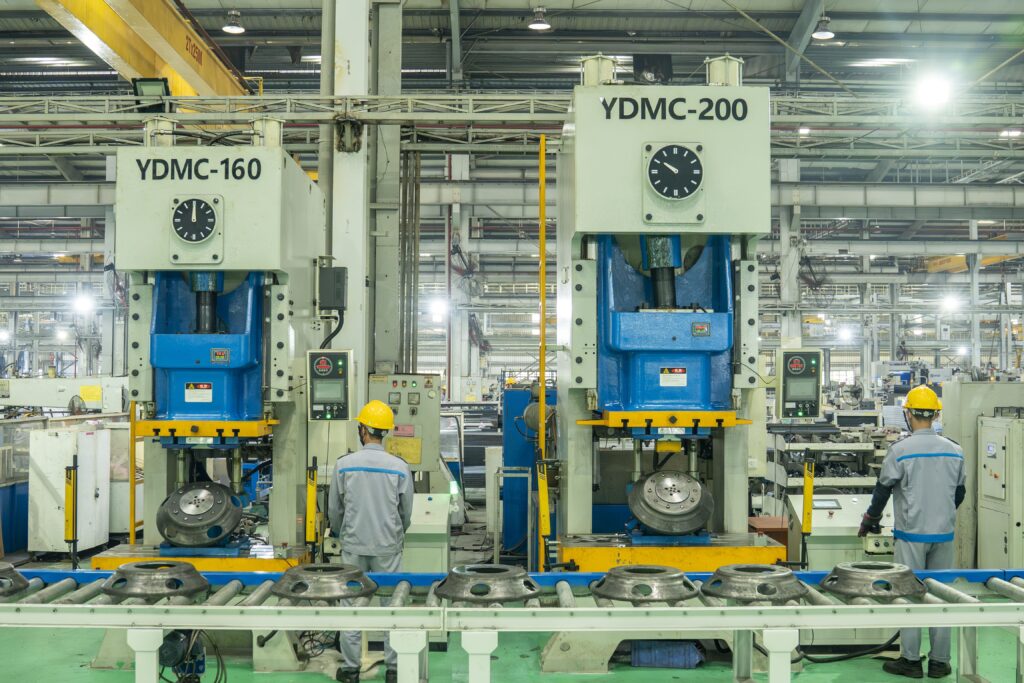
Leading OEM and industrial rim manufacturers invest heavily in advanced manufacturing technologies to achieve high productivity, dimensional accuracy, and stable production quality. Most of the digital transformation aspects in OEM rim manufacturing target quality control and process repeatability, using up-to-date machinery and equipment that aim for consistent precision and accuracy. CNC spinning machines and high-tonnage presses, for example, ensure precise shaping of rim components, while robotic MIG/MAG welding improves uniformity.
- Fundamental And Specific Certification
International certification in rim manufacturing demonstrates that production complies with established structural integrity and safety standards, such as IATF 16949:2016 and ISO 9001:2015. These quality standards provide objective verification that each rim meets its rated load capacity, fatigue resistance, and operational safety requirements.
- Quality Management
Consistent production depends on inspection systems that monitor forming accuracy and material performance. This structured approach strengthens output qualification and prevents variations between batches. Manufacturers with scalable production capacity can increase output when needed while maintaining the same level of process control.
- Production Scalability
A reliable industrial rims manufacturer must be able to scale output without sacrificing dimensional consistency or mechanical performance. This requires standardized tooling systems, stable suppliers for certified steel grades, and production lines designed for repeatability. Scalable manufacturers also plan capacity through multi-shift production, buffer inventory for critical components, and clear forecasting workflows, helping OEM customers secure stable lead times during peak demand or new model launches.
- Delivery Reliability
Reliable supply extends beyond manufacturing to include packaging, logistics coordination, and fulfillment management. Proper packaging protects rims from transport damage, while accurate documentation ensures smooth delivery and installation. Selecting suitable logistics options, whether sea freight, multimodal transport, or consolidated shipping, can help optimize container utilization. This approach reduces cost per unit while minimizing logistics-related damage and cost inefficiencies. Over time, manufacturers that ensure technical support, stable production planning, and supply continuity become strategic long-term OEM partners.
- After-Sales Support and Long-Term Partnership
After delivery, manufacturers continue to add value through technical support, warranty handling, and continuous improvement. This includes providing clear installation guidance and documentation (spec sheets, torque requirements, fitment notes), fast responses to quality claims, and structured root-cause analysis (e.g., weld/fatigue issues, impact damage, corrosion) to prevent recurrence.
While this doesn’t relate to strong production capabilities, it demonstrates a dedicated spirit, ensuring a long-term partnership built on trust and commitment. Moreover, explores how leading automotive interior manufacturers develop innovative, high-quality solutions, combining advanced production technologies with tailored OEM/ODM capabilities to meet diverse market demands for your industry.
THACO INDUSTRIES – Engineering Capabilities of Manufacturing Industrial Rims
THACO INDUSTRIES has established itself as a leading custom wheel rims manufacturer in Vietnam, combining integrated production, advanced engineering, and global supply capability. Its vertically coordinated ecosystem supports precision manufacturing and allows flexible adjustments to meet diverse OEM and industrial requirements. These are key reasons why THACO INDUSTRIES is an ideal industrial rim production.
Advanced Technology and R&D Strengths
THACO INDUSTRIES relies on advanced technologies in the production chain, such as CNC spinning machines, high-tonnage presses, MIG/MAG robotic welding stations (4–12 robots per station) in the welding process, and digital measuring systems to keep production consistent and precise.
THACO INDUSTRIES operates dedicated manufacturing lines, operating as a custom wheels rims manufacturer that ensure production consistency from the forming stages. Each line is engineered to support high-volume output while maintaining the precision required for agricultural and heavy-duty industrial rim applications.
Besides technological application, its R&D teams is also a highlight that makes THACO INDUSTRIES stand out. A strong engineering team starts with analyzing customer blueprints and operating conditions, then selecting suitable materials and reinforcement approaches that match real load, impact, and fatigue demands. With this technical foundation, THACO INDUSTRIES offers flexible customization, adjusting geometry, configurations, and performance features.
Outstanding Manufacturing Capabilities
Within the THACO INDUSTRIES ecosystems, outstanding manufacturing capabilities are organized through an integrated production model that includes stamping, tandem, truck hamming, welding, and hemming. This structure enables consistent process control and efficient collaboration between engineering and manufacturing teams, supporting the production of complex mechanical products, industrial equipment, and OEM components for global partners across multiple sectors.
International Quality Standards
Production under ISO 9001:2015 covers quality management systems, ISO 14001:2015 helps with environmental impact control, and ISO 45001:2018 ensures specified requirements for occupational health and safety. Besides common qualifications, EN 1090 and ISO 3834:2021 are also achieved to indicate a quality assurance in welding for structural steel products, or AS 4457.1 for those involved in major mining operations, and is supported by the inspectorates of Queensland, New South Wales and Western Australia.
These standards confirm controlled manufacturing processes and consistent performance across production volumes.
Multi Scale Logistics With Efficient Cost
Beyond production, THACO INDUSTRIES maintains an integrated logistics network designed to support international delivery requirements. The company combines sea freight and multimodal transport options, aligning with Incoterms Standards and delivery schedules with customer production plans and to meet specific packaging and technical requirements. Packaging is also customized to meet technical specifications and ensure stability during multimodal transport. This coordinated approach allows the company to deliver complete commercial solutions
Proven Global Credibility
As a global OEM rim supplier, THACO INDUSTRIES serves international equipment manufacturers and industrial clients through an extensive global distribution and supply network. Its integrated logistics system coordinates warehousing, inland transportation, port operations, and export documentation within a unified network, in full compliance with international Incoterms.
With strengths in research and development, advanced technology, achieving international certificates, along with in-house logistics solutions, the corporation has exported to ~30 countries, demonstrating scale and technical maturity in OEM/ODM industries.
With extensive expertise in CNC machining services and heavy steel fabrication, THACO INDUSTRIES delivers reliable solutions for industrial and infrastructure projects.
All production processes comply with IATF 16949, ISO 14001, ISO 45001, and ISO 9001 certified standards, ensuring precision, safety, and long-term performance. The production scope includes equipment and systems developed under contract manufacturing services, ODM manufacturing, and EPC manufacturing, supported by CE certified steel fabrication. These capabilities are applied across mining equipment, conveyor systems, industrial silos, and household electric supply systems for industrial applications.
With integrated production, certified quality systems, and scalable manufacturing, THACO INDUSTRIES is well positioned to support demanding OEM requirements. To discuss project specifications or partnership opportunities, contact partsales@thaco.com.vn or (+84) 389 067 557 (Ms. Linh)


