
Product information
What to Know About Lifting Equipment Manufacturers
Selecting the right lifting equipment manufacturers plays a crucial role in ensuring safe and efficient handling across industrial environments. To support procurement teams and engineering managers in making informed decisions, THACO INDUSTRIES will outline the essential criteria, technical considerations, and industry standards that define a reliable manufacturing partner. In this article, we provide a clear, engineering-focused overview to help businesses evaluate lifting equipment suppliers with confidence.
Role of Lifting Equipment Manufacturers in Industrial Operations
Lifting equipment plays a critical role in material handling across manufacturing plants, logistics centers, warehouses, and construction sites, often working alongside solutions developed by automated material handling equipment manufacturers and even a shopping trolley manufacturer in distribution and retail environments, forming a broader ecosystem that includes warehouse racking manufacturers, material handling equipment manufacturers working together to optimize efficiency and operational flow. These systems enable safe load movement, streamline workflows, and support the automated handling of heavy or bulky materials, including equipment supplied by excavator bucket manufacturers that play a key role in excavation and earthmoving operations across mining and construction sectors. Within this value chain, lifting equipment manufacturers are responsible for a comprehensive set of engineering and production activities, ranging from design and structural simulation to fabrication, assembly, quality control, and safety certification. They ensure each piece of equipment meets specific load requirements, complies with safety regulations, and performs consistently under variable operating conditions.
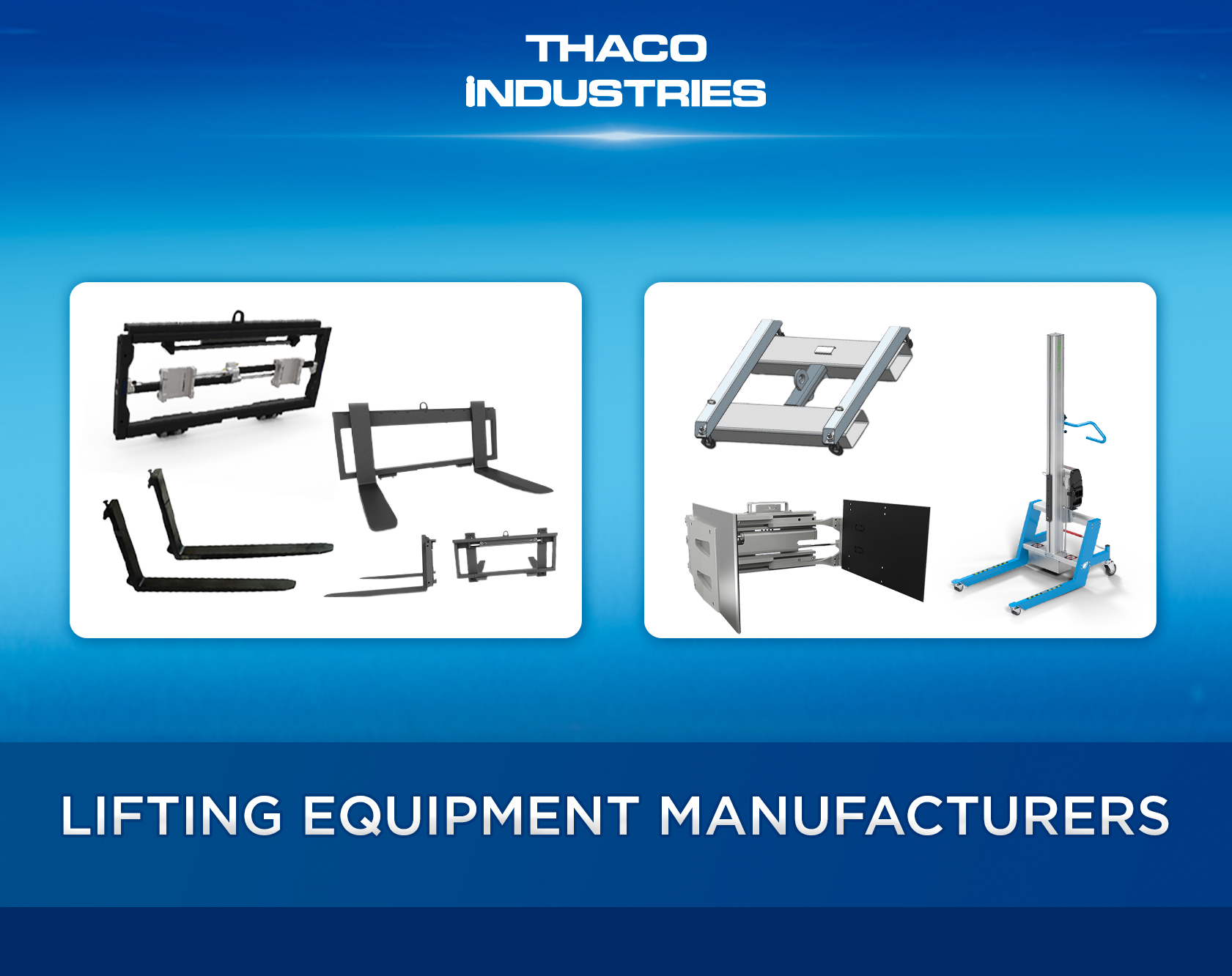
Reliable lifting equipment manufacturers contribute directly to safer operations and more efficient material handling processes. By delivering structurally robust equipment with high load stability, and minimal maintenance needs, they help industrial operators reduce downtime, enhance workplace safety, and maintain predictable throughput.
Key Standards and Certifications to Evaluate Manufacturers
Evaluating a lifting equipment manufacturer requires proven certifications, strict safety compliance, and accountable operational management. Below is a clearer, deeper breakdown of the standards that global buyers commonly use when assessing suppliers.
Quality & Management Standards
These certifications confirm that a manufacturer operates under controlled processes, demonstrates environmental responsibility, and maintains strict workplace safety systems.
- ISO 9001:2015 – Quality Management Systems: Ensures standardized production processes, traceability, and consistent product quality across all manufacturing stages.
- ISO 14001:2015 – Environmental Management Systems: Demonstrates responsible use of resources, waste reduction, and compliance with environmental regulations.
- ISO 45001:2018 – Occupational Health & Safety Management Systems: Confirms that the manufacturer maintains safe working conditions, risk-prevention practices, and continuous safety improvement programs.
Product & Safety Standards
To ensure compliance with international safety practices, operators should also understand how to safely operate an overhead crane, particularly in environments where lifting systems are used daily. These standards directly govern the structural integrity, load capacity, and operational safety of lifting equipment.
- CE Marking (EU Directive Compliance): Indicates that products comply with EU directives on safety, health, and environmental protection for machinery and lifting accessories.
- EN 13155:2003+A2:2009 – Non-Fixed Lifting Accessories: Specifies requirements for load-bearing components, including mechanical strength, stability, and fail-safe mechanisms.
- EN 1090-1 / EN 1090-2 – Structural Steel & Aluminum Components: Governs fabrication, welding quality, material traceability, and structural performance for steel structures used in lifting equipment.
- ASME B30 Series – Safety Standards for Cableways, Cranes, Derricks, Hoists, Hooks, Jacks, and Slings: Provides detailed guidelines for design, inspection, testing, and safe operation across a wide range of lifting equipment categories.
- OSHA 1910 & OSHA 1926 – Occupational Safety Standards (U.S.): Ensures lifting systems and workplace conditions meet safety rules for general industry and construction environments.
Why These Certifications Matter
Certifications confirm that lifting equipment meets defined safety margins and durability requirements under specified operating conditions. By complying with recognized international standards, manufacturers demonstrate controlled production processes covering material selection, fabrication, and load testing, reducing operational risks in demanding industrial environments. For procurement teams, these certifications also provide a practical benchmark for supplier credibility.
Core Manufacturing Capabilities in Lifting Equipment Production
Producing high-performance lifting equipment requires advanced engineering capabilities aligned with modern material handling equipment design and manufacturing standards. In many projects, coordination with an electrical panel manufacturing company is also essential to ensure proper integration of control systems, safety mechanisms, and power distribution within lifting solutions.
Key manufacturing processes include:
- Structure fabrication: Cutting, bending, and forming high-strength steel plates and profiles used for cranes, hoists, frames, and lifting attachments.
- CNC machining: Precision milling, drilling, and turning of load-bearing parts to achieve tight tolerances and consistent dimensional accuracy.
- Robotic welding: Ensures uniform weld penetration and superior fatigue resistance, especially in joints subjected to dynamic loads.
Surface treatment:
- Shot blasting for rust and scale removal, improving surface adhesion.
- Powder coating or industrial painting for corrosion resistance and long-term durability in outdoor and heavy-duty environments.
Final assembly & alignment: Integrating mechanical, hydraulic, and structural components to create complete lifting systems.
Load and performance testing: Verifying safe working loads, stability, and structural integrity before shipment.
Beyond fabrication, strong engineering capability is central to lifting equipment production. Manufacturers apply CAD/CAE tools, finite element analysis (FEA), and rapid prototyping to optimize load paths and validate designs made with durable fabricated parts material, improving fatigue life and performance, reduce weight, enhance fatigue life, and validate designs under simulated working conditions.
Within this framework, THACO INDUSTRIES leverages a fully integrated ecosystem, from workpiece processing and CNC machining to robotic welding, surface treatment & painting and assembly – all supported by automated production lines and synchronized quality control, where its specialized equipment plant supplies diverse products across multiple industrial applications, enabling consistent precision, high productivity, and reliable delivery for complex lifting equipment projects. This end-to-end workflow enables consistent precision, high productivity, and reliable delivery for diverse lifting equipment projects across industrial sectors.
How to Choose the Right Lifting Equipment Manufacturer
Selecting the right lifting equipment manufacturer is a critical decision that influences not only safety and operational efficiency but also long-term maintenance costs and overall productivity. To ensure dependable performance across demanding industrial environments, buyers should evaluate manufacturers through a combination of technical, operational, and quality-driven criteria, especially when dealing with specialized equipment categories where understanding the difference between RTG and STS cranes can impact procurement decisions.
Key factors to consider include:
- Engineering Expertise: Look for manufacturers with strong mechanical engineering capabilities, supported by CAD/CAE design, structural analysis, and prototype validation. This ensures lifting equipment is optimized for load stability, fatigue resistance, and real-world operating conditions.
- Customization Capability: Industrial operations vary widely, so the ability to tailor dimensions, load capacity, frame design, materials, and surface finishes is essential. Flexible OEM/ODM services help align equipment with specific environmental or operational requirements.
- Scalability for Large Orders: Reliable suppliers must be able to meet high-volume production demands while maintaining consistent quality. Large-scale facilities and automated production lines are indicators of strong manufacturing capacity.
- Lead Time & Supply Chain Strength: Efficient internal processes, stable supplier networks, and well-managed logistics help reduce production delays and ensure on-time delivery, especially for international clients.
- Quality Assurance & Quality Control: Evaluate whether the manufacturer has structured QA/QC systems with tests for load capacity, structural integrity, weld quality, and coating durability. Certifications such as ISO 9001, ISO 14001, and ISO 45001 add credibility.
Cost efficiency, material quality, and strict adherence to international safety standards should also be part of every procurement assessment, ensuring both economic value and operational security.
As a practical example, THACO INDUSTRIES represents a fully integrated OEM/ODM partner with strong engineering capability, large-scale fabrication infrastructure, and synchronized machining-to-assembly workflows. With global export reach across the US, EU, Australia, and Asia, the corporation delivers customized lifting equipment solutions that meet strict international standards while supporting efficient, reliable, and scalable industrial operations.
Why THACO INDUSTRIES is a Trusted Partner in Lifting Equipment Manufacturing
When evaluating lifting equipment manufacturers, buyers increasingly look for partners that can deliver not just products, but complete engineering and production solutions. THACO INDUSTRIES stands out in this landscape thanks to its fully integrated ecosystem, technical depth, and proven manufacturing discipline.
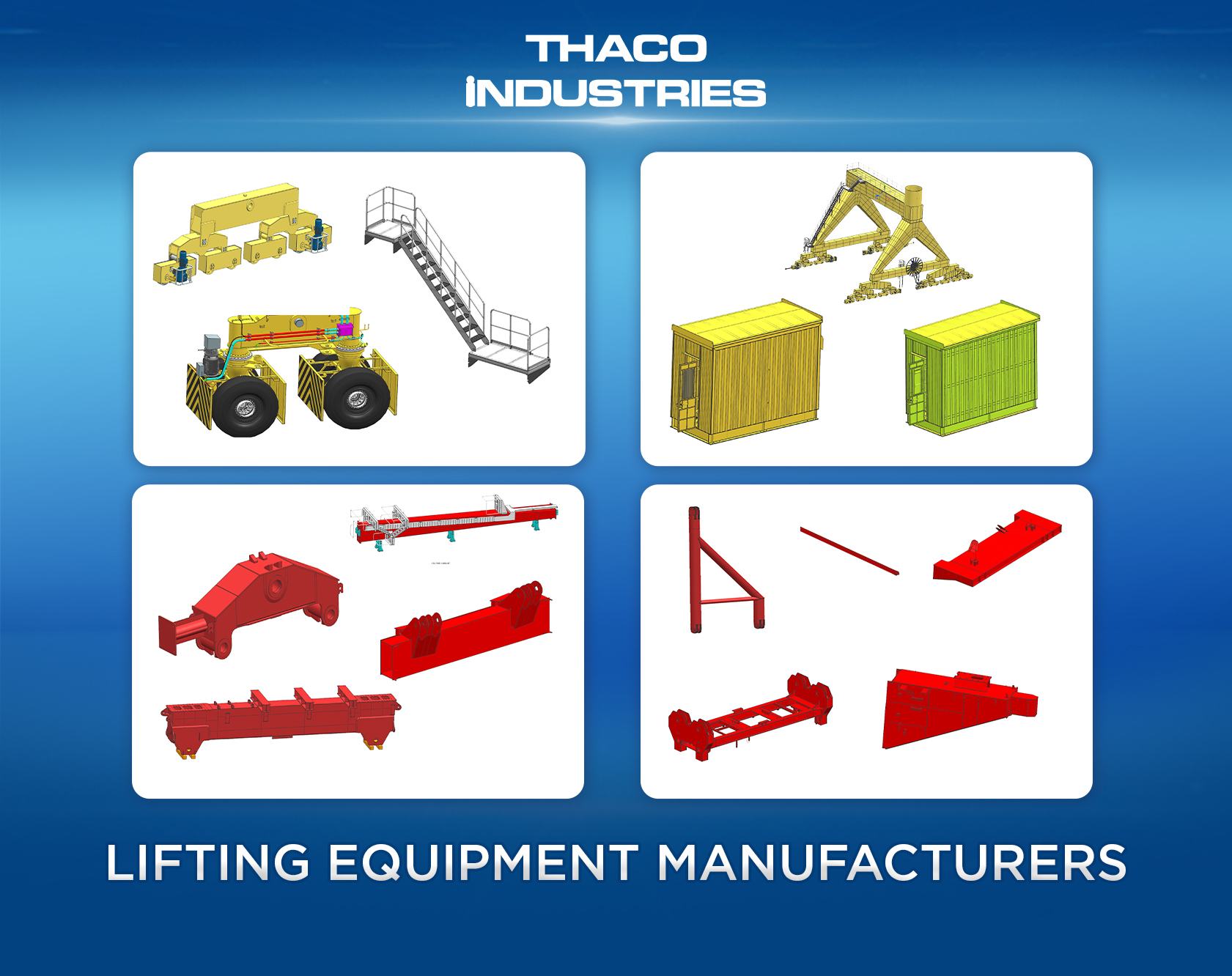
THACO INDUSTRIES provides end-to-end lifting equipment solutions, covering everything from R&D to fabrication, welding, surface treatment & finishing, and assembly. The corporation designs and manufactures a wide range of lifting structures – cranes, hoists, lifting frames, handling platforms, and heavy-duty steel assemblies – all produced within unified facilities to ensure consistency and synchronized quality control.
THACO INDUSTRIES operates Vietnam’s leading mechanical engineering centers, featuring highly automated production lines managed on a digital manufacturing platform. The center integrates advanced machining, robotic welding, and automated surface treatment and powder-coating systems, ensuring high precision, production consistency, and long-term product durability. Every production stage is tightly governed under internationally recognized management systems: ISO 9001:2015 (Quality Management) and ISO 14001:2015 (Environmental Management), ensuring both technical accuracy and responsible, standardized processes.
THACO INDUSTRIES also has practical experience supplying parts and semi-finished lifting structures to European markets, meeting stringent requirements for load integrity, weld quality, and coating performance. This capability extends across multiple manufacturing models, including Made-to-Order (MTO), Engineering-to-Order (ETO), and Make-to-Stock (MTS) production, giving partners flexibility whether they need bespoke designs or high-volume industrial output.
For long-term collaboration, THACO INDUSTRIES prioritizes NDA compliance, scalable production investment, and cost-effective engineering solutions – creating a partnership model that supports growth, confidentiality, and continuous improvement for global clients.
With extensive expertise in CNC machining services and heavy steel fabrication, THACO INDUSTRIES delivers reliable solutions for industrial and infrastructure projects.
All production processes comply with IATF 16949, ISO 14001, ISO 45001, and ISO 9001 certified standards, ensuring precision, safety, and long-term performance. The production scope includes equipment and systems developed under contract manufacturing services, ODM manufacturing, and EPC manufacturing, supported by CE certified steel fabrication. These capabilities are applied across mining equipment, conveyor systems, industrial silos, and household electric supply systems for industrial applications.
If you’re looking for a reliable, technically capable partner in lifting equipment manufacturing, THACO INDUSTRIES is ready to support your project from design to delivery.
Contact us today at: partsales@thaco.com.vn or hotline +84 348 620 063.


