
Automotive Components
OEM and Custom Leaf Spring Manufacturing for Trucks
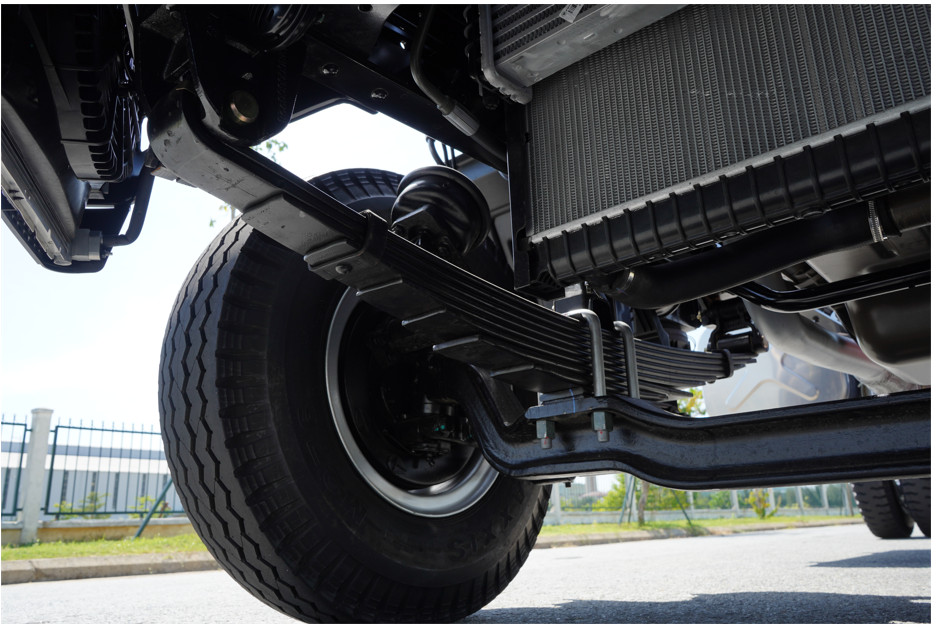
In heavy-duty trucks, the suspension system plays an important role in handling road impacts and supporting heavy loads. As vehicles travel across uneven roads, the system must absorb shocks and vibrations to keep the truck stable.
A key component that makes this possible is the leaf spring. As part of the truck suspension system, leaf springs help support the vehicle’s weight, absorb road shocks, and maintain axle stability during operation.
This article explores OEM and custom leaf spring manufacturing for trucks, including how leaf springs are engineered, the key manufacturing processes involved, and why choosing the right manufacturer is essential for performance and long-term reliability.
What Is a Truck Leaf Spring Manufacturer?
A truck leaf spring manufacturer specializes in producing leaf springs used in truck suspension systems. These components are a key part of the leaf spring suspension, functioning as a load-bearing suspension system that supports the truck’s weight while absorbing road shocks and stabilizing the axle during operation.
In addition to standard products, manufacturers may also produce custom leaf springs. Custom leaf springs are designed and manufactured according to specific vehicle configurations, axle loads, or operating requirements, rather than relying on standard off-the-shelf designs. These springs are engineered to match factors such as payload capacity, axle load distribution, and the operating conditions the truck is expected to face.
In mass production context, OEM truck leaf spring manufacturing focuses on meeting the structural and durability requirements of heavy-duty applications. Leaf springs for trucks are designed to handle high load capacities, repeated stress cycles, and demanding operating environments such as long-haul transport and uneven road conditions. The manufacturing scope includes:
- Engineering and design based on axle load and vehicle application
- Careful selection of spring steel grades
- Precision forming, controlled heat treatment, assembly, and protective surface coating.
Understanding what these manufacturers produce sets the foundation. The next step is to examine how these springs are actually made and how they are validated for performance.
Manufacturing Process for Truck Leaf Springs
Although structurally simple, truck leaf springs must withstand repeated cyclic loads and severe road conditions over an extended service life. Its reliability depends on a tightly controlled sequence of engineering and production stages. Each step builds on the previous one, and there is no room for errors.
Step-By-Step Manufacturing Process
These are the steps that manufacturers use to produce high-performance truck leaf springs.
Step 1: Design & Simulation
Engineers develop 2D and 3D structural models based on axle load, vehicle type, and operating conditions. Camber height, deflection range, and load capacity are calculated with precision.
Simulation software is then used to:
- Evaluate stress distribution across each leaf
- Predict fatigue life under repeated load cycles
- Confirm that the spring maintains structural integrity under maximum rated capacity
Design adjustments are made at this stage. This is because it’s more efficient to correct geometry digitally than to do so after tooling has begun.
Step 2: Workpiece Manufacturing
Once approved, high-grade spring steel plates are then cut to exact dimensions. The forming process follows:
- Tapering – helps to reduce stress concentration toward the leaf ends.
- Eye rolling – forms the spring eye. This allows connection to shackles or bushings.
- Ironing – it refines the thickness and improves consistency.
Automated dimensional control systems are mostly used to verify tolerances in real time. Even small deviations can affect ride height and load distribution.
Step 3: Heat Treatment
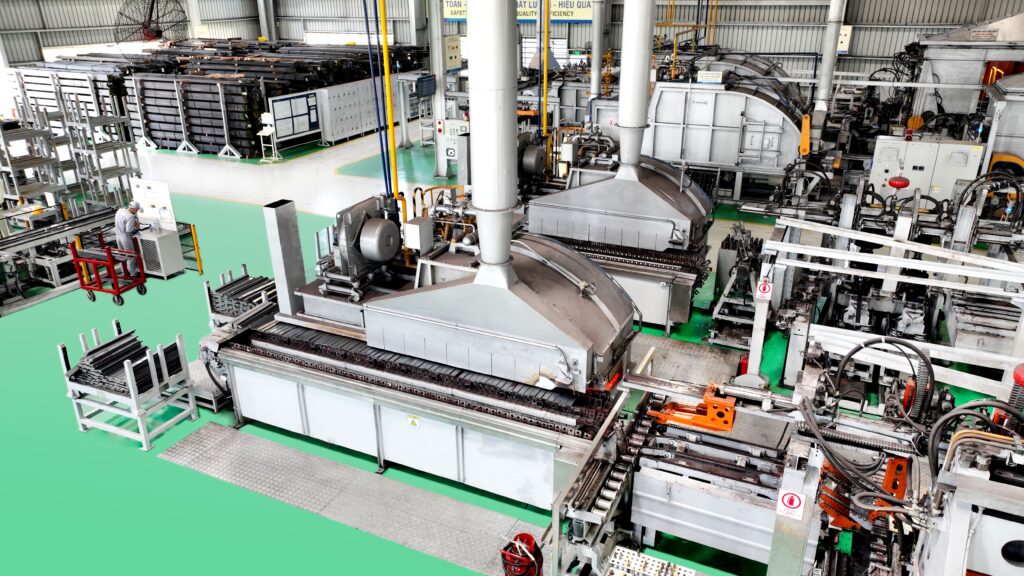
Strength comes from controlled metallurgy. Springs pass through dedicated furnaces designed for both short and long leaves. This stage determines whether the spring can withstand permanent deformation or repeated stress without cracking. The sequence typically includes precise heating to the austenitizing temperature, followed by controlled quenching to increase hardness. Lastly, tempering is done to balance elasticity and toughness.
Step 4: Shot Peening
After heat treatment, the surface is reinforced through automated shot peening. Small steel shots strike the surface at controlled velocity to create residual compressive stress.
This process:
- Reduces the likelihood of crack initiation
- Improves fatigue resistance
- Extends service life under cyclic loading in heavy-duty truck operation
Step 5: Dipping Paint (Anti-Corrosion Coating Process)
Corrosion is a silent threat to spring performance. To prevent it, leaf springs are immersed in a dipping paint bath to apply a uniform anti-corrosion coating. Immersion ensures complete coverage, including edges, curves, and inner surfaces that spraying alone may miss. This procedure allows for full submersion for uniform coating and controlled draining to remove excess material. It also enables thermal curing under regulated conditions. The dipping layer acts as a foundational protective barrier. It enhances corrosion resistance and prepares the surface for final assembly and finishing.
Step 6: Assembly
Individual leaves move along a conveyor-based system where they are stacked and aligned. Center bolts secure the pack while clips and bushings are installed according to specification. Before proceeding to the next step, load testing helps verify stiffness, camber accuracy, and structural response under rated load. Only assemblies that meet defined parameters move forward.
Step 7: Finishing Paint
Robotic systems apply the final coating to achieve consistent thickness. Color coding and marking are added for traceability. During this stage, environmental controls help maintain coating integrity and compliance with emission standards.
Step 8: Final Quality Inspection
The last stage combines mechanical testing and visual inspection. Surface finish, coating adhesion, dimensional accuracy, and performance data are reviewed before approval for packaging and shipment.
Custom Leaf Springs for Fleet and Aftermarket Needs
Not all trucks operate under the same conditions. Delivery fleets, long-haul transporters, heavy-hauling units, and off-road trucks each impose different stress patterns on suspension systems.
In addition, fleet and aftermarket requirements often differ from OEM programs because:
- Vehicles operate in varied environments and load conditions
- Load profiles change over the vehicle’s lifecycle
- Springs may be retrofitted onto existing platforms
An experienced OEM suspension supplier must understand these variations and provide custom truck suspension solutions that balance durability, ride stability, and cost efficiency.
A controlled manufacturing process, however, is only part of the equation. It must be supported by recognized standards, certifications, and consistent validation systems to guarantee long-term performance.
Why Does Manufacturer Capability Matters?
Leaf spring production involves multiple critical stages (such as design, forming, heat treatment, coating, and assembly), and each must be precisely controlled to ensure durability, safety, and consistent suspension performance.
This is why the capability of an OEM leaf spring supplier carries real weight. It is often not enough to own machines. The manufacturer must have:
- R&D and custom engineering capability: Manufacturers must have in-house engineering teams capable of performing load calculations, fatigue analysis, and structural design to develop springs that meet precise technical specifications.
- In-house engineering support to calculate load requirements accurately and refine designs before production begins.
- Controlled heat treatment and surface processing: These aspects must be carefully monitored, as hardness and elasticity are determined in this phase. Surface processes such as shot peening and coating must be consistent.
- Integrated testing and validation: Load testing, fatigue simulation, and dimensional checks confirm that the spring performs as intended.
- Speed and consistency: Fast production matters, but not at the expense of repeatability. Consistency across batches is what OEM programs depend on.
Manufacturer Capability affects whether a leaf spring performs reliably over years of service or fails prematurely under load. For buyers, the real task is evaluating which manufacturer has the systems, controls, and technical depth to consistently deliver what they promise.
Choosing the Right Truck Leaf Spring Manufacturer
Selecting the right truck leaf spring manufacturer requires more than comparing prices or production capacity. Buyers should evaluate several technical and operational factors to ensure the supplier can consistently deliver durable suspension components that meet vehicle requirements and long-term performance expectations. Key aspects to consider include:
- Engineering and technical capability: A qualified manufacturer should have in-house engineers who understand axle load calculations, stress distribution, and vehicle application requirements. The ability to adjust designs based on real operating conditions is essential.
- Manufacturing process control: Ask how key stages are managed. For instance, heat treatment must be carefully monitored to prevent premature corrosion.
- Testing, validation, and quality assurance: Load testing verifies stiffness and camber, while fatigue testing evaluates long-term durability under repeated cycles. All these inspection procedures should be documented and repeatable.
- Standards and certifications: Compliance with IATF 16949:2016, ISO 9001:2015, and ISO 14001:2015 indicates structured quality management and environmental responsibility.
- OEM and aftermarket support: The manufacturer should demonstrate the capacity to serve both large-scale OEM programs and diverse replacement needs without compromising consistency.
Partner with THACO INDUSTRIES for OEM Truck Leaf Spring Manufacturing
THACO INDUSTRIES operates as a long-term OEM manufacturing partner, not merely a parts supplier. The focus is on collaboration, engineering alignment, and production stability. Its leaf springs support truck manufacturers across export markets, including the USA, Australia, Germany, Dominica, and Korea, etc. Below are the key differentiators that ensure THACO INDUSTRIES meets demanding technical and regulatory expectations.
End-to-End OEM Manufacturing
THACO INDUSTRIES manages the entire production cycle internally. Engineering and R&D teams develop application-specific designs, supported by large-scale automated production lines operating at approximately 85% automation. There’s also an integrated testing and quality assurance system that verifies load performance and durability before shipment. The company has experience supplying global automotive and industrial customers, where consistency and traceability are essential.
Large-Scale Production Backed By Reliable Ecosystem
Production volume alone does not guarantee reliability. A solid industrial ecosystem is still needed. Within THACO INDUSTRIES’ manufacturing ecosystem, leaf springs are produced at a dedicated facility operated by the Automotive Springs Company. This specialization allows tighter process control and focused quality management for commercial vehicle applications.
Automotive-Grade Quality Certified for Global Markets
All the operations comply with ISO 9001:2015,ISO 14001:2015, and IATF 16949:2016standards. This means that production supports structured quality management and environmental responsibility throughout the manufacturing stages.


