
Automotive Components
Agricultural Rims Manufacturer for Modern Farming Equipment
Modern farming relies on machinery that operates under varied loads and long duty cycles. The rim is a critical structural component that supports these demands while maintaining stability and efficiency. A deep understanding of how agricultural rims are designed and selected ensures reliable performance and long-term equipment operation.
The Importance of Rim Quality Matters in Agricultural Machinery
Rims contribute a large margin in agricultural tyre operations, as they carry the weight of the machinery. They function as key elements in the driveline system, transmitting engine torque to the tyres and ensuring effective traction and power transfer to the ground. When choosing heavy-duty agricultural rims, there are a couple of factors to consider.
- Load-bearing Performance
The maximum weight the rim can support without deforming or failing structurally is often referred to as its load-bearing capacity. Rims do the heavy lifting in supporting this load and in keeping the tires securely in place, even in tough working conditions. High-load tractor rims often come with load capacity ratings calculated based on the maximum axle load. For example, an agricultural rim made of high-strength steel can achieve load ratings of up to 3,500 lbs per wheel, depending on rim profile and axle configuration.
- Operational Safety and Stability
Rim quality directly influences vehicle stability, especially when equipment operates on uneven or soft terrain. Structurally sound rims maintain proper tire seating and alignment, hence they help preserve steering control and load balance. This becomes particularly important when operating on slopes, where uneven load distribution can compromise handling and increase mechanical stress on axle components.
- Durability and Service Life
Steel is a material of choice when looking for durable farm rims. They bend more easily and offer a good service life for their weight compared to other alloys. The rims should also have surface treatment and powder coating to enhance resistance to soil, moisture from the immediate environment and corrosion from fertilizers and other farm chemicals.
- Compatibility with Tire Systems
Agricultural rims must be precisely matched to tire dimensions and bead profiles to ensure secure mounting and stable operation. This alignment allows tire systems to perform as intended, especially when using large-diameter or low-pressure tires designed for agricultural use.
- Compliance with Industry Standards
Manufacturing standards and certifications provide assurance that rims meet defined structural and quality requirements. Standards such as ISO 9001:2015 and ISO 3834:2021 govern process control and welding quality, while industry-specific standards such as TRA and SAE J3229_202402 define load performance and durability expectations for agricultural wheels.
Agricultural Rim Manufacturing Process
Agricultural rim production follows a standardized, vertically integrated workflow from technical requirement definition to final manufacturing.
Raw Materials And Steel Selection
Due to the nature of agricultural machinery, high-quality steel is the ideal material for withstanding higher static loads and exposure to moisture and chemicals that accelerate corrosion..
Blank Fabrication, Precision Machining, and Welding
The manufacturing specification for each rim may vary based on the customer’s design expectations and the final use of the agricultural machinery. Even so, the rim manufacturing process is such that steel is first formed into the rim blank using roll forming or hydraulic shaping to achieve the correct diameter and thickness. Precision machining is then used to create accurate bolt holes and mounting surfaces, which allows for proper installation on agricultural equipment. Finally, the rim and disc are then welded together, typically using automated systems for consistent joint strength.
Surface Treatment And Coating Process
This is an important stage in steel rim manufacturing, where the welded rim is blasted with tiny steel balls at high speed to remove rust, dirt, and welding residue. The rim is then dipped into a liquid paint bath, and through an electrodeposition (ED) coating process, an electric current pulls the coating evenly over the entire surface.
To get a tough outer layer that protects the ED surface, powder coating is applied. As a final step, the surface is tested for corrosion resistance and adhesion.
Quality Control And Load Testing
Before approving rims for delivery, they are first inspected against defined dimensional tolerances. All the production and inspection procedures take place within controlled manufacturing environments.
Acceptance testing is conducted in accordance with international standards, such as DOT (Department of Transportation) requirements and FMVSS No. 120 for road safety compliance. TRA standards define tire-rim compatibility and load-rating validation. Load, bending fatigue, and radial fatigue tests are also applied to confirm long-term durability under agricultural operating conditions.
Types of Agricultural Rims Manufactured
Rim selection must always be aligned with the machine’s function, load behavior, and operating environment. Below are the most common rim types in agriculture.
- Tractor Front And Rear Rims
Agricultural rims manufacturers must match front and rear rim dimensions to tire size and axle configuration to maintain proper load distribution and steering stability. On front-wheel-drive tractors, rim geometry directly influences front-wheel lead, which affects traction efficiency and long-term drivetrain wear. When tubeless tires are used, rim profile and bead seat design become especially important.
- Combine Harvester Rims
Compared to tractor rims, harvester rims prioritize structural rigidity and load distribution over steering dynamics. They are known for their reinforced designs and specific bolt patterns that accommodate sustained heavy loads. Harvester rims are often engineered to support low-pressure tires that improve flotation and reduce soil compaction.
- Trailer And Implement Rims
These rims are designed to support hauled loads, common with lifting equipment. Unlike automotive rims, they are not intended for sustained highway speeds, and their load ratings and stress tolerance differ significantly. Interchanging trailer rims with car or tractor rims increases the risk of fatigue failure and handling instability.
- Custom-Engineered Rims for OEM Requirements
Depending on the requirements of different agricultural operations, custom-engineered rims’ specifications are adjusted accordingly, such as dual wheels on tractors are now an accepted way of improving the drawbar output of tractors, providing extra traction without compaction giving valuable flotation in wet conditions.
In the modern farming industry, this compatibility enhances energy transfer efficiency, reduces vibration, and prevents mechanical stress. As a result, operators experience smoother operation, reduced wear on components, and improved overall system reliability.
Custom Agricultural Rims For OEMs
Custom agricultural rims for OEMs are designed to meet specific machinery operations, regulatory requirements across different agricultural applications. When receiving customized requests, the engineering team needs to look at the bigger picture, considering other underlying factors such as agricultural techniques, machinery structure, wheel diameter, dimensional tolerances, load ratings, material thickness and axle structure in order to fine-tune the precise parameters to meet the buyer’s needs.
One of the common factors is environmental conditions. Soil chemistry, humidity levels, farming practices, and fertilizer or chemical exposure place distinct demands on wheel assemblies, which often require suitable coating solutions, such as power coating, E-coating (electrophoretic painting). For abrasive or dry environments, material thickness and fatigue resistance are adjusted to withstand increased mechanical wear.
Other parameter-level adjustments include customized rim diameters, bolt patterns, offset values, bead seat profiles, and reinforcement structures. These customizations ensure seamless integration with axle systems, drivetrains, and tire configurations, adapting to various farming techniques and guaranteeing smooth operation over extended periods.
THACO INDUSTRIES produces OEM agricultural rims through engineering-to-order manufacturing, with precise control over rim diameter, bolt patterns, and load specifications. Tight dimensional accuracy supports proper fitment and stable load transfer. Scalable production enables a reliable supply of custom tractor rims and bulk agricultural rims for OEMs and distributors operating across varied agricultural conditions.
Standards And Certifications In Agricultural Rim Manufacturing
Compliance is a critical aspect of the agricultural rim manufacturing process. Quality assurance systems such as ISO 9001:2015 govern process consistency and traceability to ensure that each rim can be verified against the set specifications.
Another standard is ISO 3834:2021 (a welding quality specification), which specifies weld quality and production procedures that affect fatigue life and load performance.
Structural strength and endurance are verified under SAE J3229, a testing standard developed specifically for agricultural and off-road wheels. Where required, FMVSS No. 120 specifies wheel load marking and identification requirements for road-going vehicles with a GVWR exceeding 10,000 lb. These include trucks and trailers used in regulated markets.
Beyond internal control, certification supports export readiness. Certified rim manufacturers can access global markets with their ISO agricultural rims.
Key Criteria For Selecting An Agricultural Rims Manufacturer
Agricultural applications impose operating conditions that differ from those of commercial vehicles. These are the aspects to consider when choosing a reliable agricultural rims supplier.
- Manufacturing Scale And Automation
Most agricultural rim factories employ automated forming and welding systems that support high-volume manufacturing with predictable quality. This capability is essential for OEM programs that require both precision and continuity.
- Engineering Expertise
A qualified manufacturer must understand load behavior, tire interaction, axle geometry, and environmental exposure specific to agricultural machinery. Such expertise enables meaningful technical consultation and ensures rim specifications are aligned with real operating demands.
- Consistent Quality Control
Agricultural rims must be produced under standardized, repeatable processes to maintain consistency across batches. Manufacturers with controlled inspection and acceptance procedures reduce variability and protect against premature fatigue or corrosion-related failure.
- Delivery Lead Time Reliability
The best manufacturers have stable capacity and disciplined production planning that enable them to meet delivery schedules without compromising manufacturing standards. This reliability reduces supply risk for OEMs and distributors.
- After-sales And Technical Support
Responsive technical support allows manufacturers to address performance feedback and support long-term product optimization. This collaboration is essential for sustaining reliability across diverse agricultural environments.
Choose THACO INDUSTRIES as Your Agricultural Rims Manufacturer
Selecting an agricultural rims manufacturer requires confidence in process control and long-term production stability. THACO INDUSTRIES delivers these requirements through an integrated manufacturing ecosystem built to meet OEM and global market standards.
- Integrated Industrial Ecosystem
THACO INDUSTRIES operates within a vertically integrated industrial ecosystem. The corporation now manages the full production chain, from Business, R&D Center, Manufacturing, Installation, to Warranty and Repair.
Operating as a custom wheels rims manufacturer that ensure production consistency from the earliest forming stages, THACO INDUSTRIES designs a production line that unifies design, tooling, forming, coating, and inspection within a single, controlled production flow, enabling the engineering of rims across a wide range of sizes and configurations, with designs that match real operating conditions in different applications.
- Advanced Manufacturing And Supply Lines
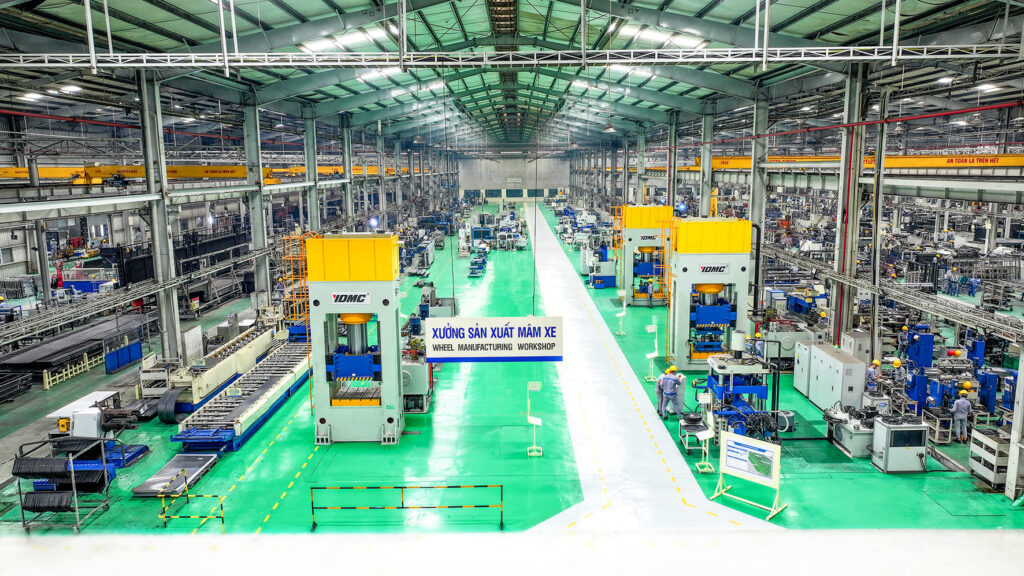
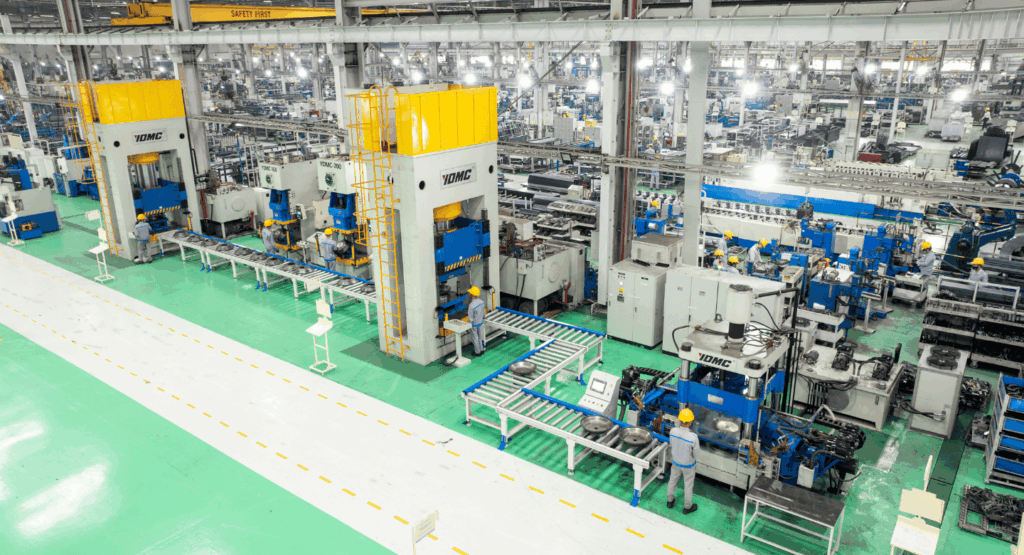
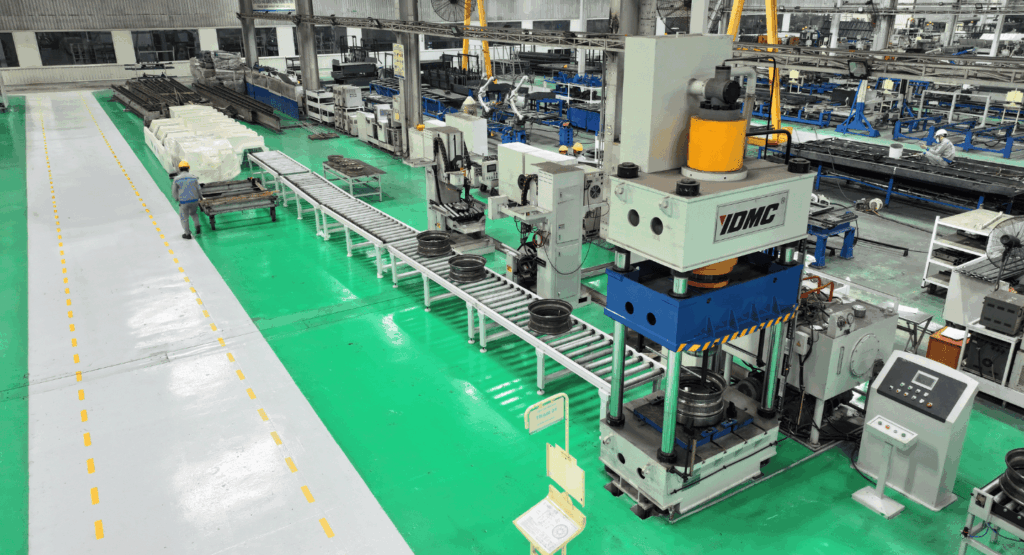
THACO INDUSTRIES operates dedicated manufacturing lines, each engineered to support high-volume output while maintaining the precision required for agricultural and heavy-duty wheel applications. The production lines are equipped with machinery and equipment imported from Germany, Switzerland, Japan, and South Korea, ensuring stable operation and high manufacturing accuracy. A standard production line includes high-capacity stamping machines, CNC drilling and turning machines, butt welding machines, rim and disc pressing machines, and an advanced quality control system featuring fine-tuning machines, airtightness testing machines, concentricity testing machines, and dynamic balancing machines.
Agricultural equipment operates across diverse load profiles and environmental conditions, which means rims should be engineered for specific use cases. Variations in axle load, duty cycle, terrain, and operating environment require careful evaluation at the design stage to ensure long-term performance.
Additionally, THACO INDUSTRIES has invested in an integrated manufacturing mode, offering a wide range of solutions meeting different demands, from customizing rim diameters, bolt patterns, offset values, bead seat profiles, to reinforcing structures, all optimized based on axle load distribution, traction demands, and dynamic stress behavior.
- Highlighted Products from THACO INDUSTRIES
Apart from THACO INDUSTRIES’s agricultural rims, the manufacturer also produces a range of high-precision rims like truck-bus and semi-trailer rims that reflect the same engineering discipline applied to wheel production.
To ensure the process achieves the desired quality, THACO INDUSTRIES also focuses on investing in modern production machinery systems the corporation manufactures other areas of activity, such as high-tech equipment with electrical and electronic equipment, high-tech devices, automation solutions, and intelligent robots utilizing artificial intelligence, domestic appliances, industrial equipment, automotive molds for complex metal-forming operations.
Industrial rims produced by THACO INDUSTRIES serve a wide range of industries, including automotive manufacturing and assembly, mining, construction, agriculture, and logistics, meeting the demands of both domestic and international markets.
- Consistent Quality Control
THACO INDUSTRIES’ manufacturing processes are also aligned with internationally recognized standards. The following certifications signal trustworthiness and readiness for global markets.
- ISO 9001:2015 – Quality management systems that ensure process control and consistent output.
- ISO 14001:2015 – This standard helps companies control environmental impact and ensure compliance with environmental regulations.
- ISO 3834:2021 – This is a welding quality standard that is critical for structural safety and fatigue performance.
- EN 1090:2018 – Structural execution standards required for CE-marked load-bearing steel or aluminum components.
- Delivery Lead Time Reliability
Not only focusing on the manufacturing process, THACO INDUSTRIES also strengthen trustworthiness through proactively ensuring punctual delivery, building long-term partnerships with OEMs and distributors across Vietnam and international markets such as Asia, Europe, and North America, fitting with Incoterms requirements.
By addressing demands through sustained investment in research and development, THACO INDUSTRIES maintains direct control over core production and logistics stages, THACO INDUSTRIES can fulfill large orders in time – without sacrificing quality.


